Table of Contents
Have you ever settled into your living room after a long day, ready to unwind with the perfect mood lighting, only to be greeted by an annoying flicker or a dimmer that just won’t play nice with your new smart bulbs? You’re not alone. The dream of effortlessly adjusting your home’s ambiance with a voice command or a tap on your phone often hits a snag when the fundamental component – the dimmer switch itself – isn’t chosen with care. It’s frustrating to invest in smart home tech only to find basic functionality compromised by compatibility issues or poorly designed features. This isn’t just about convenience; it’s about creating a seamless, reliable experience that truly enhances your daily life.
Choosing the right smart dimmer switch is less about chasing the “hottest new gadget” and far more about understanding your specific home’s electrical setup, your lighting goals, and the underlying technology that makes smooth, quiet, and compatible dimming possible. Many enthusiasts jump in excitedly, only to face returns, professional installation calls, or settling for subpar performance because they overlooked critical factors like bulb compatibility or neutral wire requirements. This guide cuts through the marketing noise, focusing squarely on the essential considerations and features you must evaluate to ensure your smart dimmer investment delivers the flawless, responsive, and integrated lighting control you envision for your automated home. Let’s build that solid foundation for success.
Top 10 Smart Dimmer Switches
Detailed Product Reviews
1. Kasa Smart Dimmer Switch HS220, Single Pole, Needs Neutral Wire, 2.4GHz Wi-Fi Light Switch Works with Alexa and Google Home, UL Certified, No Hub Required, 1 Pack

Overview:
The Kasa Smart Dimmer Switch HS220 is a single-pole Wi-Fi dimmer requiring a neutral wire, designed for seamless integration into modern smart homes. It enables remote light control via the Kasa app and supports voice commands through Alexa or Google Assistant without needing a hub. Installation is guided by the app, though professional help is advised for wiring novices.
What Makes It Stand Out:
Its standout features include “Gentle Off” for fading lights during bedtime and robust scheduling with Away Mode to deter intruders via randomized on/off cycles. The precise 2.4GHz Wi-Fi connectivity ensures reliable app-based control from anywhere, and UL certification underscores safety and durability.
Value for Money:
Priced affordably for a single unit, it delivers premium functionality like advanced scheduling and voice control without subscription fees. While basic, it outperforms non-dimmable smart switches at similar prices, though multi-packs offer better long-term value for whole-home setups.
Strengths and Weaknesses:
Strengths: Intuitive app interface, reliable voice integration, Gentle Off feature, and no hub required. Weaknesses: Requires neutral wire (limiting older homes), 2.4GHz Wi-Fi only, and lacks Matter protocol for broader ecosystem compatibility.
Bottom Line:
Ideal for beginners seeking a no-frills, budget-friendly smart dimmer with essential features. Best for single-room use, but those upgrading multiple switches should consider multi-packs for savings.
2. Kasa Smart Dimmer Switch HS220P3, Single Pole, Needs Neutral Wire, 2.4GHz Wi-Fi Light Switch Works with Alexa and Google Home, UL Certified,, No Hub Required, 3-Pack

Overview:
This 3-pack of Kasa HS220P3 dimmers offers identical core functionality to the single HS220 but at a reduced per-unit cost. Each switch requires a neutral wire and 2.4GHz Wi-Fi, supporting app-based control, voice commands, and scheduling for hassle-free smart lighting management across multiple rooms.
What Makes It Stand Out:
The bulk-pack pricing provides exceptional value for whole-home installations. Features like 0%-100% dimming, double-click fade-off for bedtime, and sunrise-inspired scheduling stand out, alongside consistent performance and Kasa’s user-friendly app guidance for setup.
Value for Money:
Significantly cheaper per switch than buying singles, this pack is economical for multi-room setups. It matches competitors’ features (voice control, scheduling) while avoiding hub fees, making it a cost-efficient upgrade for 3+ rooms without sacrificing reliability.
Strengths and Weaknesses:
Strengths: Bulk savings, smooth dimming range, reliable app/voice control, and no hub needed. Weaknesses: Neutral wire requirement excludes some homes, no Matter support, and identical limitations to the single-unit model across all three switches.
Bottom Line:
The top choice for cost-conscious users retrofitting multiple rooms. Delivers Kasa’s trusted performance at scale, though neutral-wire dependency remains a barrier for pre-1980s wiring.
3. TREATLIFE Smart Dimmer Switch 4 Pack, Single Pole Smart Switch Works with Alexa and Google Home, Neutral Wire Required, 2.4GHz WiFi Dimmer Light Switch for LED, CFL, Incandescent Bulbs

Overview:
TREATLIFE’s 4-pack provides a budget-friendly smart dimmer solution for single-pole setups, requiring a neutral wire and 2.4GHz Wi-Fi. It supports dimmable LED, CFL, and incandescent bulbs (up to 150W/400W) and integrates with Alexa, Google Assistant, and the TREATLIFE app for remote control.
What Makes It Stand Out:
The 4-pack offers the lowest per-switch cost among competitors, with unique features like memory of last brightness settings after power loss and family-sharing app access. Its explicit bulb compatibility guidance prevents common installation issues.
Value for Money:
Unbeatable for large-scale installations—ideal for cost-focused users upgrading 4+ rooms. While lacking premium features like Matter support, it covers essentials (scheduling, voice control) at a fraction of the price of single-brand alternatives.
Strengths and Weaknesses:
Strengths: Excellent multi-pack value, bulb compatibility clarity, last-setting memory, and family sharing. Weaknesses: No Matter/HomeKit support, strict dimmable-bulb requirement, and limited to single-pole configurations (no 3-way support).
Bottom Line:
A pragmatic pick for budget-heavy deployments in newer homes. Compromises on ecosystem flexibility but excels in affordability and core functionality for non-Apple households.
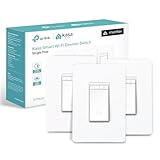
4. Kasa Smart Kasa Matter Smart Dimmer Switch: Voice Control w/Siri, Alexa & Google Assistant,UL Certified, Timer & Schedule, Easy Guided Install,Neutral Wire Required, Single Pole, 2.4GHz Wi-Fi, 3-Pack
Overview:
Kasa’s Matter-enabled 3-pack dimmer leverages the unified Matter protocol for cross-platform compatibility, supporting Apple Home, Alexa, Google, and SmartThings. It retains core features like app control and scheduling but adds future-proofed smart home integration without requiring a hub.
What Makes It Stand Out:
Matter compatibility is the game-changer—enabling seamless control via Siri, Alexa, or Google simultaneously, even offline via LAN. The 3-pack format balances whole-home coverage with next-gen interoperability, while 1%-100% dimming ensures precision.
Value for Money:
Priced higher per unit than non-Matter Kasa switches, the premium is justified by Matter’s longevity and cross-ecosystem flexibility. Multi-admin support and LAN control add value for tech-savvy users, making it a strategic investment over cheaper alternatives.
Strengths and Weaknesses:
Strengths: Matter protocol for universal compatibility, multi-admin access, reliable dimming, and no hub dependency. Weaknesses: Higher cost, neutral wire requirement, and identical 2.4GHz Wi-Fi limitations as older models.
Bottom Line:
The smart choice for users invested in multiple ecosystems (Apple/Google/Amazon). Worth the extra cost for future-proofing, though overkill for Alexa/Google-only households.
5. Leviton Decora Smart Dimmer Switch, Wi-Fi 2nd Gen, Neutral Wire Required, Works with Matter, My Leviton, Alexa, Google Assistant, Apple Home/Siri & Wired or Wire-Free 3-Way, D26HD-1RW, White

Overview:
Leviton’s premium dimmer combines Matter support with unique 3-way compatibility (wired or wire-free) and specialized lighting features. It requires a neutral wire but works across Apple Home, Alexa, Google, and Leviton’s app, targeting users seeking advanced ambiance control.
What Makes It Stand Out:
Standout features include customizable fade rates, My Leviton Night Settings for automatic low-light mode, and flicker prevention for LED bulbs. Its 3-way flexibility (unmatched by competitors) accommodates complex wiring, while Matter ensures broad ecosystem access.
Value for Money:
Priced at a premium, it justifies cost through superior build quality, niche features like night settings, and versatile 3-way support. Ideal for high-end installations where ambiance and reliability outweigh budget concerns.
Strengths and Weaknesses:
Strengths: 3-way compatibility, flicker prevention, Night Settings, and Matter integration. Weaknesses: Highest price point, neutral wire dependency, and steeper learning curve for advanced features.
Bottom Line:
The ultimate pick for luxury setups needing 3-way support or nuanced lighting control. Over-engineered for basics but unmatched for sophisticated, multi-scene smart homes.
6. TP-Link Tapo Matter Smart Dimmer Switch: Voice Control w/Siri, Alexa & Google Assistant, UL Certified, Timer & Schedule, Easy Guided Install, Neutral Wire Required, Single Pole, Tapo S505D(2-Pack)

Overview:
The TP-Link Tapo S505D 2-Pack is a Matter-certified smart dimmer switch enabling precise lighting control via app, voice, or schedule. Designed for single-pole installations, it requires a neutral wire and 2.4GHz Wi-Fi, targeting users seeking seamless integration across major smart home ecosystems.
What Makes It Stand Out:
Its Matter certification ensures future-proof compatibility with Apple HomeKit, Google Home, Alexa, and SmartThings without platform lock-in. Full 0-100% dimming, intuitive app-guided setup, and unified voice control (including Siri) set it apart. The 2-pack offers immediate multi-room coverage.
Value for Money:
Priced competitively for a 2-pack, it delivers exceptional value for multi-room setups. While pricier than single-switch alternatives, Matter certification justifies the cost by avoiding obsolescence as ecosystems evolve. Neutral wire requirement limits retrofit appeal but ensures reliability.
Strengths and Weaknesses:
Strengths: Universal Matter compatibility; robust scheduling with “Away Mode”; reliable dimming; UL-certified safety; easy app-guided install.
Weaknesses: Neutral wire mandatory (excludes older homes); no physical toggle; limited to 2.4GHz Wi-Fi; Matter setup may confuse beginners.
Bottom Line:
Ideal for tech-savvy homeowners building a multi-platform smart home. Its Matter support and 2-pack value make it a top-tier investment for flexible, long-term lighting control—despite neutral wire constraints.
7. Amazon Basics Smart Dimmer Switch, Single Pole, Works with Alexa Only, Voice Control, 2.4 GHz Wi-Fi, No Hub Required, Neutral Wire Required, White

Overview:
This budget-friendly Amazon Basics dimmer simplifies smart lighting for Alexa-centric households. It replaces standard switches with voice/app control for dimming, requiring neutral wiring and 2.4GHz Wi-Fi but no hub—perfect for Amazon ecosystem users.
What Makes It Stand Out:
Its exclusive Alexa integration streamlines setup and daily use for Amazon devotees. The guided installation video and Alexa app control (including routines) prioritize accessibility over multi-platform flexibility, making it uniquely approachable for beginners.
Value for Money:
The lowest-cost option reviewed, it’s ideal for single-switch upgrades. Savings come at the cost of ecosystem flexibility—no Google/Siri support—but excels as a dedicated Alexa accessory. Neutral wire requirement remains a universal limitation.
Strengths and Weaknesses:
Strengths: Extremely affordable; effortless Alexa integration; simple app control; no hub needed; reliable neutral-wire operation.
Weaknesses: Alexa-only compatibility; basic scheduling (no “Away Mode”); no physical dimmer knob; limited dimming customization.
Bottom Line:
A no-frills, budget pick for Alexa loyalists wanting basic voice-controlled dimming. Avoid if you use Google Home or Apple ecosystems, but excellent value for straightforward Amazon-centric automation.
8. TP-Link Tapo Smart Dimmer Switch, Single Pole, Neutral Wire Required, 2.4GHz Wi-Fi Light Switch Compatible with Alexa and Google Home, UL Certified, No Hub Required, White, Tapo S500D(4-Pack)

Overview:
TP-Link’s Tapo S500D 4-Pack delivers expansive smart lighting control without Matter certification. Compatible with Alexa and Google Assistant, it offers app-guided installation, 1-100% dimming, and robust scheduling—tailored for cost-conscious users covering multiple rooms.
What Makes It Stand Out:
The 4-pack provides unmatched value for whole-home deployment at a mid-range price. Tapo’s app enables granular dimming control, “Away Mode” security features, and smooth scheduling. While lacking Matter support, its broad Alexa/Google compatibility covers most mainstream needs.
Value for Money:
Exceptional for multi-switch setups—the 4-pack undercuts buying four individual switches elsewhere. Neutral wire dependency affects older homes, but UL certification and no-hub requirement ensure safety and simplicity, justifying the investment for new builds/renovations.
Strengths and Weaknesses:
Strengths: Cost-effective 4-pack; intuitive app dimming; strong “Away Mode”; UL safety certified; no hub required.
Weaknesses: No Siri/HomeKit support; neutral wire essential; scheduling less advanced than Matter rivals; basic physical design.
Bottom Line:
The best budget-friendly bulk solution for Alexa/Google users. Prioritizes affordability and core smart features over cutting-edge Matter integration—perfect for whole-home dimming on a practical budget.
9. Kasa Apple HomeKit Smart Dimmer Switch KS220P3, Single Pole, Neutral Wire Required,2.4GHz Wi-Fi Light Works with Siri, Alexa and Google Home,UL Certified, No Hub Required,White, 3 Count (Pack of 1)

Overview:
Kasa’s KS220P3 is engineered for Apple-centric homes, offering HomeKit compatibility alongside Alexa/Google support. This 3-pack includes unique “Gentle Off” for bedtime routines, requiring neutral wiring and 2.4GHz Wi-Fi for seamless iOS integration.
What Makes It Stand Out:
True HomeKit support (with Apple TV/HomePod) enables Siri remote control—a rarity in multi-platform switches. The standout “Gentle Off” feature slowly dims lights to aid sleep, while “Away Mode” enhances security. App-guided installation simplifies setup.
Value for Money:
Priced higher due to HomeKit specialization, the 3-pack offsets cost for Apple households. Neutral wire necessity limits retrofitting, but the blend of iOS optimization, triple-voice assistant support, and security features justifies the premium for Apple users.
Strengths and Weaknesses:
Strengths: Full HomeKit/Siri integration; gentle fade-off; robust scheduling; reliable multi-voice support; UL certified.
Weaknesses: HomeKit remote requires Apple hub device; neutral wire mandatory; slightly complex initial setup; no Matter support.
Bottom Line:
Essential for Apple ecosystem adopters wanting premium HomeKit features. The “Gentle Off” and Siri compatibility make it worth the investment—though non-Apple users should consider alternatives.
10. Kasa Smart Dimmer Switch HS220, Single Pole, Needs Neutral Wire, 2.4GHz Wi-Fi Light Switch Compatible with Alexa and Google Home, UL Certified, No Hub Required, Black

Overview:
Kasa’s HS220 in sleek black delivers refined smart dimming with smooth fade transitions. Compatible with Alexa, Google, and SmartThings, it requires neutral wiring and 2.4GHz Wi-Fi, emphasizing user experience through tactile and app-based control.
What Makes It Stand Out:
The “Fade On/Off” feature eliminates jarring light changes—uniquely enhancing ambiance. Kasa’s app offers precise 1-100% dimming, customizable schedules, and intuitive voice control. Its matte black finish and responsive physical toggle elevate aesthetics beyond competitors.
Value for Money:
Mid-priced for single-switch quality, it excels in user experience over raw features. Neutral wire requirement is standard, but fade functionality and durable build justify the cost for those prioritizing seamless daily interaction over ecosystem breadth.
Strengths and Weaknesses:
Strengths: Smooth fade transitions; responsive physical dimmer; elegant black finish; reliable app/scheduling; no hub needed.
Weaknesses: Neutral wire essential; no HomeKit/Siri native support; scheduling lacks “Away Mode” randomness; limited to single-pole use.
Bottom Line:
A top choice for design-conscious users wanting premium tactile control and ambiance-focused dimming. Best paired with Alexa/Google ecosystems—ideal if fade effects outweigh multi-platform flexibility needs.
Understanding Core Compatibility Requirements
Before you even glance at features like scheduling or voice control, nailing down compatibility is non-negotiable. This is where most smart dimmer projects stumble. Your chosen switch must harmonize with your existing electrical system and, crucially, the bulbs you plan to use. Ignoring this step guarantees frustration down the line.
Deciphering Your Electrical Circuit Type
Your home’s wiring configuration is the bedrock of compatibility. The most critical factor is whether your switch box has a neutral wire. Modern smart dimmers almost universally require a neutral wire to power their internal electronics reliably without causing flickering or standby issues. Older homes, particularly those wired before the 1980s, often lack neutrals at the switch box, relying solely on “hot” and “load” wires. If you don’t have a neutral, your options shrink significantly, often requiring specialized (and sometimes less feature-rich) dimmers designed for “no-neutral” installations, which can have limitations like requiring specific bulb types or exhibiting slight glow when off.
Matching Bulb Technology Perfectly
Not all dimmable bulbs dim equally well with all dimmers, regardless of smart features. LED bulbs, now the standard, are particularly sensitive. You must verify compatibility between the dimmer switch and the specific LED (or CFL) bulbs you intend to use. Look for dimmers explicitly listing compatibility with popular LED brands and models on their spec sheets. Pay close attention to the dimmer’s minimum and maximum load requirements – using bulbs that fall below the minimum load (common with just one or two efficient LEDs) can cause flickering, buzzing, or failure to turn off completely. Trailing-edge (electronic low-voltage) dimmers are generally the best match for modern LEDs, while leading-edge (incandescent/magnetic low-voltage) dimmers are better suited for older halogen or incandescent setups.
Verifying Voltage and Load Capacity
Smart dimmers are designed for specific voltage ranges (typically standard 120V in North America) and have strict maximum wattage limits. Exceeding the wattage capacity is a fire hazard and will damage the dimmer. Calculate the total wattage of all bulbs on the circuit you intend to control. Remember, while a single 60W incandescent is fine, ten 10W LEDs (totaling 100W) might exceed the dimmer’s limit if it’s rated for only 150W resistive load (LEDs often require a lower effective wattage rating). Always check the dimmer’s specifications for both resistive (incandescent/halogen) and LED/CFL load capacities, and ensure your total bulb wattage falls safely below the LED rating.
Mastering Dimming Technology and Performance
Beyond basic on/off control, the quality of the dimming experience separates a functional switch from a truly delightful one. Smooth, quiet, and flicker-free dimming across the entire range is essential for creating the ambiance smart home enthusiasts seek. Understanding the technology behind it is key.
Leading-Edge vs. Trailing-Edge Dimming Explained
The core technology dictates compatibility and performance. Leading-edge dimmers (Triac-based) chop the front of the AC waveform and are traditional for incandescent and halogen bulbs. They are generally less expensive but often cause buzzing or flickering with LEDs and have a higher minimum load. Trailing-edge dimmers (Transistor-based, often MOSFET) chop the back of the waveform. They are significantly quieter, offer smoother dimming down to very low levels (often 1% or less), handle lower wattages better, and are the preferred choice for the vast majority of modern LED installations. Ensure your dimmer specifies trailing-edge technology if using LEDs.
Achieving Smooth Dimming Range and Low-End Performance
A high-quality smart dimmer shouldn’t just dim; it should dim well from 100% all the way down to a gentle glow. Pay attention to the specified dimming range – look for switches boasting 1% or 0.1% minimum dim levels. Poor low-end performance results in lights cutting out too high or exhibiting noticeable flicker/strobing as you approach the bottom of the dimming curve. This is heavily influenced by both the dimmer’s design and its compatibility with your specific bulbs. Reviews often mention low-end performance, so seek out user experiences with similar bulb types.
Eliminating Audible Buzz and Flicker
Audible buzzing from the switch itself or visible flickering in the lights are major red flags for poor dimmer-bulb synergy or an inadequate dimmer design. Quality trailing-edge dimmers incorporate better filtering and circuitry to minimize electromagnetic interference (EMI) that causes buzzing. Flicker usually stems from incompatibility (wrong dimmer type, load below minimum) or poor power regulation within the dimmer. While some flicker might be bulb-specific, a well-matched, high-quality dimmer should operate silently and produce perfectly stable light output across its entire range.
Essential Smart Features Beyond Dimming
The “smart” aspect is where integration and convenience come alive. While dimming is the core function, the value for home automation enthusiasts lies in how seamlessly the switch connects with the rest of your ecosystem and automates your lighting experience.
Robust Platform Integration
Your dimmer must speak the language of your smart home hub. Determine your primary ecosystem first: Is it Apple HomeKit (requiring Matter over Thread or specific certification), Google Home, Amazon Alexa, Samsung SmartThings, or a proprietary hub? Not all dimmers work universally. Prioritize switches that offer native, reliable integration with your chosen platform without requiring complex workarounds or unreliable third-party “skills.” Check for Matter support, as this emerging standard promises better cross-platform compatibility long-term.
Advanced Scheduling and Automation Capabilities
True automation shines with features beyond simple voice commands. Look for dimmers that allow creating complex schedules (e.g., “Gradually brighten lights at 7 AM on weekdays,” “Dim to 30% at 9 PM Sundays”), sunrise/sunset triggers, and robust support for automations within your smart home app. Can it trigger other devices? (“When I dim the living room lights to 20%, turn on the TV ambiance lights”). Granular control over these automations directly impacts how effortlessly your lighting adapts to your life.
User Experience and Control Flexibility
How you interact with the dimmer daily matters immensely. Evaluate the physical switch design (is the toggle smooth? Does it have a clear indicator light?), the responsiveness and intuitiveness of the companion app, and the reliability of voice commands. Does the switch offer physical control that works even if your Wi-Fi is down? Good switches provide multiple reliable control paths: physical toggle, app, voice, and automation. A laggy app or inconsistent voice response quickly erodes the smart home dream.
Practical Installation and Design Considerations
Getting the tech right is only half the battle. How the dimmer fits into your wall, how it looks, and how easy it is to install significantly impact satisfaction, especially for DIYers.
Physical Dimensions and Wallplate Compatibility
Smart dimmers often require more space inside the electrical box than standard switches due to their internal electronics and radios. Measure your existing switch box depth – older homes frequently have shallow boxes. Ensure the dimmer you choose physically fits. Also, verify compatibility with standard US single-gang, double-gang, etc., wallplates. Some smart dimmers have unique shapes or require specific decorative plates, limiting your aesthetic options.
Aesthetic Integration with Your Décor
Your switches are visible elements in your home. Consider the finish (white, black, graphite, metallic), the style of the toggle or slider, and the presence and color of status LEDs. Do you prefer a minimalist look that blends in, or a switch that makes a subtle design statement? Some offer customizable LED colors to indicate status (e.g., blue for on, amber for dimmed). Choose a design that complements your interior style for a cohesive look.
DIY Friendliness vs. Professional Installation Needs
While many smart dimmers are marketed as DIY-friendly, the reality depends heavily on your electrical knowledge and your home’s wiring. If you lack a neutral wire, installation becomes significantly more complex and potentially unsafe for non-electricians. Even with a neutral, misidentifying wires can be dangerous. Honestly assess your skill level. If unsure, always hire a licensed electrician. Safety must trump cost savings. Look for dimmers with clear, step-by-step instructions and well-labeled terminals to aid DIYers who are qualified.
Heat Dissipation and Long-Term Reliability
Dimmers generate heat, especially when controlling higher loads near their maximum capacity. Quality units incorporate effective heat sinks and thermal management. Poor heat dissipation leads to premature failure. Check reviews for mentions of overheating issues, particularly when used at high loads. A dimmer that runs cool to the touch during normal operation is a good sign of robust engineering and potential longevity.
Powering Your Smart Home Ecosystem
Smart dimmers don’t exist in isolation; they’re nodes within a larger network. Understanding how they connect and communicate is vital for system-wide reliability and future-proofing.
Connectivity Protocols: Wi-Fi, Zigbee, Z-Wave, Thread
How the dimmer connects to your network impacts range, reliability, and hub requirements. Wi-Fi dimmers connect directly to your router but can congest your network and drain phone battery (for local control). Mesh protocols like Zigbee, Z-Wave, or Thread require a separate hub but offer better range (as devices relay signals), lower power consumption, and often faster, more reliable local control (works without internet). Thread, especially via Matter, is becoming the gold standard for reliability and future compatibility. Consider your existing hub setup and long-term smart home plans when choosing the protocol.
Local Processing vs. Cloud Dependency
This is a critical reliability factor. Dimmers relying solely on the cloud for basic functions (like turning on/off via voice) become useless if your internet goes down. Prioritize dimmers that support “local control” – meaning commands processed directly by your hub on your home network, requiring only power and local network connectivity. This ensures your lights remain responsive during internet outages, a crucial aspect of a dependable smart home. Check specifications explicitly for local execution capabilities.
Matter and Future-Proofing Your Investment
Matter is a new, open-standard connectivity protocol built on IP (Internet Protocol) designed to simplify smart home setup and ensure interoperability across brands and ecosystems. Matter-over-Thread is particularly promising for reliable, local, and secure device communication. Choosing a dimmer that supports Matter (even if via a future update) significantly future-proofs your investment, reducing the risk of the device becoming obsolete if a platform changes or disappears. It’s increasingly a mark of a forward-thinking product.
Frequently Asked Questions
Frequently Asked Questions
Why does my smart dimmer flicker or buzz with my LED bulbs? Flickering or buzzing is almost always a compatibility issue. It could mean the dimmer isn’t designed for your specific LED bulbs (check compatibility lists), the total bulb wattage is below the dimmer’s minimum load requirement, or you have a leading-edge dimmer paired with LEDs that need trailing-edge. Verify bulb compatibility and load specifications.
Do I absolutely need a neutral wire for a smart dimmer? For the vast majority of modern, feature-rich smart dimmers, yes, a neutral wire is essential. It provides a constant power path for the dimmer’s electronics. While “no-neutral” options exist, they often have limitations like requiring specific bulb types, potentially causing slight glow when off, or lacking some advanced features. Always check the specific dimmer’s requirements.
Can I use a smart dimmer with any dimmable LED bulb? No, not all dimmable LEDs are compatible with all smart dimmers. Dimmability depends on the bulb’s internal driver circuitry matching the dimmer’s technology (usually trailing-edge). Always consult the dimmer manufacturer’s compatibility list for verified bulb models to ensure smooth, flicker-free performance.
What’s the difference between leading-edge and trailing-edge dimming? Leading-edge dimmers (older tech) chop the front of the AC wave, best for incandescent/halogen, often buzz with LEDs. Trailing-edge dimmers chop the back of the wave, are quieter, smoother for LEDs down to very low levels, and handle lower loads – they are the standard recommendation for modern LED lighting.
Why won’t my lights dim all the way down to zero? This is usually due to the dimmer’s minimum dim level setting or a compatibility issue with the bulbs. Quality trailing-edge dimmers often go down to 1% or 0.1%. If lights cut out too high, check the dimmer’s specs, ensure bulb compatibility, and verify the total load isn’t below the minimum requirement.
Can I install a smart dimmer myself, or do I need an electrician? If you are experienced with basic home electrical work, have the correct tools (voltage tester!), and your switch box has the required wires (especially a neutral), DIY installation is possible following instructions meticulously. If you lack a neutral, are unsure about wiring, or feel uncomfortable, always hire a licensed electrician for safety.
What does “minimum load” mean for a dimmer? Minimum load is the lowest total wattage of bulbs the dimmer needs to operate correctly. Using bulbs with a total wattage below this (common with just one or two efficient LEDs) often causes flickering, buzzing, or failure to turn off. Calculate your bulb wattage and ensure it meets or exceeds the dimmer’s specified minimum load for LEDs.
Why does my smart dimmer feel warm during use? Some warmth is normal as dimmers dissipate heat from regulating power. However, it should never be excessively hot to the touch. Excessive heat can indicate the dimmer is overloaded (total bulb wattage exceeding max rating), poor ventilation in the switch box, or a failing unit. Ensure you’re within the wattage limits.
What’s the biggest advantage of a Matter-compatible smart dimmer? Matter compatibility, especially over Thread, ensures your dimmer will work reliably across multiple smart home platforms (Apple, Google, Amazon, etc.) without being locked into one ecosystem. It prioritizes local control for responsiveness and stability, even without internet, and offers better long-term interoperability as the standard grows.
How do I know if a dimmer supports local control (works without internet)? Check the product specifications or marketing materials explicitly for terms like “local control,” “local execution,” “works without internet,” or “requires hub for local control.” Dimmers using Zigbee, Z-Wave, or Thread with a compatible hub are more likely to offer robust local control than Wi-Fi-only models, which often rely heavily on the cloud.
See Also
- The 10 Best Dimmer Switches Every Smart Home Enthusiast Needs This Year
- We Tested 50 Smart Dimmer Switches - Here are the 10 Best for Home Use
- We Tested 50 Smart Dimmer Switches - Here are the 10 Best for Home Integration
- 10 Essential Dimmer Switches with Remote Control Every Smart Home Needs in 2026
- 10 Premium Smart Dimmer Switches for Luxury Smart Homes (Worth the Investment)