Table of Contents
Imagine walking into a room that instantly adapts to your mood, energy levels, and daily routine without you touching a single switch. That’s the promise of next-generation smart LED strip lights transforming home automation in 2026. These aren’t just simple color-changing ribbons anymore—they’re sophisticated lighting ecosystems that learn your preferences, sync with your circadian rhythm, and seamlessly integrate with every smart device in your home.
The landscape of intelligent lighting has evolved dramatically, moving beyond basic smartphone control to embrace artificial intelligence, advanced sensors, and universal connectivity standards. Whether you’re looking to create immersive entertainment experiences, boost your productivity with tailored lighting scenes, or simply reduce energy consumption, understanding what makes these modern marvels truly “game-changing” will help you make informed decisions for your smart home setup.
Top 10 Smart LED Strip Lights
Detailed Product Reviews
1. Govee RGBIC LED Strip Lights, Smart LED Lights for Bedroom, Bluetooth LED Lights APP Control, DIY Multiple Colors on One Line, Color Changing LED Strip Lighting Music Sync, Home Decor, 16.4ft

Overview: The Govee RGBIC LED Strip Lights offer a 16.4-foot length of addressable LED lighting that displays multiple colors simultaneously on a single strip. Controlled via Bluetooth through the Govee Home App, these lights bring dynamic color combinations and music synchronization to bedroom decor without requiring WiFi or voice assistants.
What Makes It Stand Out: The RGBIC technology is the star here, allowing segmented color control that traditional RGB strips cannot match. The ability to display rainbow effects and complex color patterns along one line creates visually stunning displays. The 11 music sync modes with high-sensitivity mic integration transform any room into an immersive environment that pulses with your audio, while the DIY community features let users share and discover custom lighting designs.
Value for Money: Priced competitively for RGBIC technology, these lights deliver premium segmented color effects at a mid-range price point. While lacking WiFi and voice control might seem limiting, the cost savings are substantial compared to Govee’s WiFi-enabled models. For users prioritizing visual impact over smart home integration, this represents excellent value, especially considering the robust app features and regular AI theme updates.
Strengths and Weaknesses: Strengths:
- True RGBIC segmented color technology
- Excellent music synchronization with 11 modes
- Active DIY community and AI-generated themes
- Reliable Bluetooth app control
- 64+ preset scenes for instant ambiance
Weaknesses:
- No Alexa or Google Assistant compatibility
- Bluetooth range limitations
- No WiFi means no remote access
- 16.4ft length may be insufficient for larger spaces
- Cannot extend or connect additional strips
Bottom Line: Ideal for users seeking impressive visual effects without needing voice control, these Govee RGBIC lights excel in bedrooms and entertainment spaces where Bluetooth connectivity suffices. The segmented color technology justifies the purchase for ambiance enthusiasts.
2. KSIPZE 100ft Led Strip Lights RGB Music Sync Color Changing Led Lights with Smart App Control Remote Led Lights for Bedroom Room Lighting Flexible Home Décor

Overview: The KSIPZE 100ft LED Strip Lights provide extensive coverage with a full 100-foot length, controlled through both a smart app and included IR remote. These RGB lights offer music synchronization, timing functions, and 16 million color options, making them suitable for large-scale home decorating projects and holiday lighting.
What Makes It Stand Out: The dual control system (app + IR remote) provides flexibility that many competitors lack, ensuring you can always adjust settings even if your phone isn’t handy. The 100-foot length at this price point is exceptional value, perfect for wrapping entire rooms. The timing function allows for automated scheduling, turning your lights on/off at preset times—a feature often reserved for higher-end models.
Value for Money: This is budget-friendly bulk lighting at its finest. Offering 100 feet for roughly the price of premium 16-foot strips, KSIPZE delivers massive coverage without breaking the bank. While you sacrifice RGBIC technology and voice control, the sheer length and included timing features make this unbeatable for decorating large spaces on a budget. Perfect for seasonal decorators.
Strengths and Weaknesses: Strengths:
- Massive 100-foot length (great value)
- Dual app and IR remote control
- Built-in timing and scheduling functions
- Strong adhesive for easy installation
- Multi-scene application (bedroom, kitchen, holidays)
Weaknesses:
- No RGBIC segmented colors (basic RGB only)
- No voice assistant compatibility
- Music sync less refined than premium brands
- Single 100ft roll can be unwieldy to install
- Build quality adequate but not premium
Bottom Line: For maximum coverage at minimum cost, these KSIPZE strips are hard to beat. They’re perfect for holiday decorating, dorm rooms, or renters wanting dramatic lighting without major investment. The IR remote is a practical backup control method.
3. Govee 100ft RGBIC LED Strip Lights, Smart LED Lights Work with Alexa and Google Assistant, LED Lights for Bedroom WiFi App Control Segmented DIY Multiple Colors, Color Changing Light, (2 x 50ft)

Overview: Govee’s 100ft RGBIC LED Strip Lights combine addressable color technology with WiFi connectivity and voice assistant support. Split into two 50-foot rolls, these lights offer segmented multi-color displays along their entire length, compatible with Alexa and Google Assistant for comprehensive smart home integration.
What Makes It Stand Out: The marriage of RGBIC technology with full smart home integration sets this apart. Unlike the Bluetooth version, you get voice control plus the ability to display multiple colors simultaneously across 100 feet. The dual-roll design simplifies installation in large spaces, while the 11 music modes with high-sensitivity mic create room-filling synchronized light shows. AI-generated themes from photos add creative flair.
Value for Money: While significantly more expensive than basic RGB strips, you’re paying for true RGBIC technology across a massive length plus WiFi/voice capabilities. Compared to buying multiple shorter RGBIC strips, this 100ft package offers savings. For smart home enthusiasts wanting premium visuals throughout large rooms, the investment is justified. The quality and features match the premium price point.
Strengths and Weaknesses: Strengths:
- True RGBIC across 100 feet (two manageable rolls)
- Alexa and Google Assistant compatibility
- WiFi app control with remote access
- Advanced music sync with 11 modes
- AI theme generation and active community
Weaknesses:
- Premium pricing may deter budget buyers
- Requires 2.4GHz WiFi network
- Setup more complex than basic strips
- Power supply needs careful planning for full length
- Overkill for small spaces
Bottom Line: The ultimate choice for smart home enthusiasts wanting premium segmented color effects across large spaces. If you have the budget and desire voice-controlled, addressable lighting for your entire room, this Govee 100ft system delivers exceptional performance and flexibility.
4. DAYBETTER Smart WiFi Led Lights 100ft, Tuya App Controlled Led Strip Lights, Work with Alexa and Google Assistant, Timer Schedule, Color Changing Led Lights for Bedroom Party Kitchen

Overview: DAYBETTER’s 100ft Smart WiFi LED Strip Lights offer app and voice-controlled RGB lighting through the Tuya app, compatible with Alexa and Google Assistant. These customizable strips feature music synchronization, timer scheduling, and easy cutting marks, providing flexible smart lighting for extensive home installations.
What Makes It Stand Out: The Tuya app integration provides broad smart home ecosystem compatibility beyond just voice assistants. The group control function allows simultaneous management of multiple strips, ideal for whole-home lighting schemes. Timer scheduling is particularly robust, offering both time-of-day automation and countdown functionality. The ability to cut every 3 LEDs without damage provides installation flexibility many competitors lack.
Value for Money: Positioned as a mid-range WiFi-enabled option, DAYBETTER delivers solid smart features at a competitive price. While lacking RGBIC technology, the comprehensive app controls, voice assistant support, and 100-foot length offer good value for users wanting basic smart lighting across large areas. It’s a practical compromise between premium features and affordability.
Strengths and Weaknesses: Strengths:
- WiFi control via Tuya app with remote access
- Alexa and Google Assistant voice control
- Robust timer and scheduling options
- Cuttable design every 3 LEDs
- Group control for multiple strips
- 12V with short circuit protection
Weaknesses:
- Standard RGB (no segmented colors)
- Tuya app less polished than Govee Home
- Music sync is basic compared to RGBIC models
- Single 100ft roll can be challenging to handle
- Adhesive may require reinforcement over time
Bottom Line: A solid mid-range choice for users wanting WiFi and voice control without paying RGBIC premiums. The cutting flexibility and group control make it ideal for custom installations. Good for first-time smart lighting buyers.
5. Govee Smart RGB LED Strip Lights, 16.4ft WiFi LED Strip Lighting Work with Alexa and Google Assistant, 16 Million Colors with App Control and Music Sync LED Lights for Bedroom, Home Decor

Overview: Govee’s 16.4ft Smart RGB LED Strip Lights offer WiFi-enabled voice control through Alexa and Google Assistant. These non-RGBIC lights provide 16 million colors across 150 bright LED beads, featuring music sync, timer functions, and easy installation with included support clips.
What Makes It Stand Out: The combination of WiFi connectivity, voice assistant support, and Govee’s polished app ecosystem in a shorter, more manageable length makes this ideal for focused applications. The 150 LED beads deliver exceptionally bright, even illumination for a 16.4ft strip. The inclusion of five support clips with the adhesive provides superior mounting security compared to adhesive-only solutions. Govee’s mature app offers reliable performance and regular updates.
Value for Money: These sit at a sweet spot price point—more expensive than basic Bluetooth models but cheaper than RGBIC versions. For users wanting voice control without needing segmented colors, this offers excellent value. You get premium brand reliability, WiFi features, and bright output in a package suitable for smaller spaces. The quality justifies the modest premium over no-name brands.
Strengths and Weaknesses: Strengths:
- WiFi and voice assistant compatibility
- Bright, even illumination with 150 LEDs
- Includes support clips for secure installation
- Reliable Govee Home app with timer functions
- Good for gifts and smaller spaces
- ETL-listed adapter for safety
Weaknesses:
- No RGBIC segmented color technology
- Limited to 16.4ft (no extension option)
- Music sync less dynamic than RGBIC models
- WiFi setup may intimidate non-tech users
- Premium price for non-addressable LEDs
Bottom Line: Perfect for users wanting smart voice control in smaller spaces without needing advanced RGBIC effects. Ideal for bedrooms, kitchens, or as gifts. Offers Govee quality and app ecosystem at an accessible price point for entry-level smart lighting.
6. Kasa Smart LED Light Strip, 16.4ft WiFi LED Strip Works with Alexa, Google Home, SmartThings, High Brightness with 16 Million Colors, RGB, Grouping, Adjustable Length, Up to 25,000 Hours (KL400L5)

Overview: The Kasa Smart LED Light Strip delivers robust smart home integration in a 16.4-foot package. Designed for seamless connectivity, this WiFi-enabled strip works directly with Alexa, Google Home, and SmartThings without requiring a separate hub. With 16 million colors and high brightness output, it transforms any space with vibrant, saturated lighting tailored to your mood or activity.
What Makes It Stand Out: True smart home enthusiasts will appreciate the deep ecosystem integration. The Smart Actions feature sets it apart—your lights can automatically respond when your Kasa camera detects motion or other triggers. Advanced animated lighting effects go beyond basic color changes, offering dynamic presets perfect for gaming setups, movie nights, or parties. The grouping capability lets you synchronize multiple Kasa devices for coordinated scenes.
Value for Money: Priced in the mid-range for smart strips, the KL400L5 justifies its cost through reliable WiFi connectivity and genuine smart home automation capabilities. While cheaper Bluetooth options exist, the hub-free WiFi integration and 25,000-hour lifespan represent solid long-term value for those invested in the Kasa ecosystem.
Strengths and Weaknesses: Strengths include seamless voice control, excellent smart home integration, high brightness, and durable construction. The adjustable cutting points offer installation flexibility. However, the directional controller connection can be tricky during setup, and the 16.4-foot length may be insufficient for larger rooms. The Kasa app occasionally experiences connectivity hiccups.
Bottom Line: This is an excellent choice for smart home users seeking reliable WiFi integration and automation. If you already use Kasa devices or want serious smart home connectivity, the KL400L5 delivers despite its shorter length and minor setup quirks.
7. Govee RGBIC LED Strip Lights, 32.8ft Smart LED Lights for Bedroom, Bluetooth LED Lights APP Control, DIY Multiple Colors on One Line, Color Changing LED Strip Lighting Music Sync, Home Decor

Overview: The Govee RGBIC LED Strip Lights offer impressive visual flair with their signature multi-color-per-line technology. Spanning 32.8 feet, this Bluetooth-controlled strip brings dynamic lighting to bedrooms and entertainment spaces without requiring WiFi. The ability to display multiple colors simultaneously creates vibrant, flowing effects that traditional RGB strips simply cannot match.
What Makes It Stand Out: The RGBIC technology is the star here, allowing segmented color control along the entire strip for stunning gradients and animated patterns. With 64+ preset scenes and 11 music modes, customization is extensive. The Govee Home App fosters a creative community where users share DIY effects, and AI-generated themes provide fresh inspiration regularly.
Value for Money: This strip punches above its weight class, offering premium RGBIC technology at a budget-friendly price point. While it lacks WiFi and voice assistant support, the feature-rich app and superior visual effects make it a better value than many basic RGB strips. The length-to-price ratio is excellent for bedroom installations.
Strengths and Weaknesses: Strengths include spectacular multi-color effects, responsive music sync, extensive preset library, and generous length. The app is intuitive and regularly updated. However, Bluetooth-only connectivity means limited range and no voice control, which may disappoint smart home users. It also requires your phone to be within Bluetooth range for control.
Bottom Line: Perfect for those prioritizing visual impact over smart home integration. If you want stunning, music-reactive lighting for a bedroom or gaming space without breaking the bank, this Govee strip excels. Smart home enthusiasts should look elsewhere.
8. DAYBETTER LED Strip Lights 200 ft (2 Rolls of 100 ft), Smart App Control Lighting Bedroom Rome Decor with Remote, RGB Music Sync Color Changing LED Lights for Party
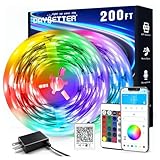
Overview: DAYBETTER’s massive 200-foot offering comes as two 100-foot rolls, making it ideal for whole-room or commercial installations. This strip combines app and IR remote control with music synchronization capabilities, providing flexible operation for large-scale decorative projects. The sheer length accommodates extensive bedroom, ceiling, or party setups that shorter strips cannot handle.
What Makes It Stand Out: The exceptional length is the obvious differentiator, allowing continuous coverage of large spaces without needing multiple controllers. The dual control methods—smartphone app and traditional IR remote—ensure accessibility for all users. Smart timing settings with color memory add convenience for daily routines and scheduled events.
Value for Money: On a per-foot basis, this represents outstanding value for large installations. While the feature set is more basic than premium brands, the sheer quantity of LED coverage for the price is hard to beat. It’s perfect for renters, party planners, or those wanting maximum coverage without premium smart home costs.
Strengths and Weaknesses: Strengths include incredible length, dual control options, music sync, and strong adhesive backing. The timer and memory functions work reliably. However, brightness and color saturation lag behind premium competitors. The app is functional but less polished, and there’s no voice assistant integration. Installation can be challenging due to the sheer volume of strip.
Bottom Line: Best suited for those needing maximum coverage on a budget. If you want to illuminate a large space for parties or dramatic effect without smart home features, this delivers exceptional length-per-dollar value. Quality-conscious users should consider premium alternatives.
9. DAYBETTER LED Strip Lights 130ft Lights Strip for Bedroom, Desk, Indoor Room Bedroom Brithday Gifts RGB Decor with Remote and 24V Power Supply

Overview: DAYBETTER’s 130-foot strip strikes a balance between length and manageability for indoor residential use. Designed for bedroom and desk applications, it offers app and IR remote control with music synchronization. The included 24V power supply provides stable performance for the extended length, making it suitable for continuous runs without voltage drop issues common in longer strips.
What Makes It Stand Out: The 130-foot length is generous for most bedroom and living room applications, while the 24V power supply ensures consistent brightness across the entire strip. The combination of app and remote control provides flexibility, and the music sync feature adds entertainment value for parties or personal enjoyment.
Value for Money: This strip offers excellent length-to-price ratio, positioning itself as a budget-friendly alternative to premium brands. While it lacks advanced features like RGBIC or smart home integration, the reliable performance and substantial coverage make it a solid value for decorative purposes. It’s ideal for users wanting maximum visual impact without premium pricing.
Strengths and Weaknesses: Strengths include impressive length, stable 24V power delivery, dual control methods, and effective music synchronization. The timer function with color memory is practical. Weaknesses include basic RGB color mixing (no multi-color segments), no voice assistant support, and an app that feels dated. Color accuracy and brightness are decent but not exceptional.
Bottom Line: A practical choice for large-space decoration on a budget. If you need extensive coverage for a bedroom, dorm, or party area without requiring smart home integration, this delivers reliable performance. For advanced effects or voice control, consider Govee or Kasa alternatives.
10. Govee Smart RGBIC LED Strip Lights 65.6ft, Alexa LED Light Strip Work with Google Assistant, Music Sync, DIY Multiple Colors on One Line, WiFi Color Changing Lights for Bedroom, Living Room, Holiday

Overview: Govee’s flagship Smart RGBIC LED Strip combines advanced segmented color technology with full smart home integration. The 65.6-foot length provides ample coverage for bedrooms or living rooms, while WiFi connectivity enables voice control through Alexa and Google Assistant. This represents Govee’s premium offering for users wanting both stunning visuals and smart convenience.
What Makes It Stand Out: The RGBIC technology allows multiple colors simultaneously per segment, creating fluid gradients and dynamic effects impossible with standard RGB strips. Voice control integration is robust, with Alexa supporting scene and music mode changes. The Govee Home App offers AI-generated themes from photo uploads and a thriving community for sharing custom effects, keeping the experience fresh.
Value for Money: Positioned as a premium option, it commands a higher price but delivers features that justify the cost. The combination of RGBIC technology, WiFi connectivity, and extensive preset scenes (64+) rivals more expensive brands. For smart home users wanting cutting-edge lighting effects, this offers excellent value compared to similarly equipped competitors.
Strengths and Weaknesses: Strengths include spectacular multi-color effects, reliable voice control, responsive music sync with 11 modes, and excellent app ecosystem. The length is generous for most applications. Weaknesses include occasional WiFi connectivity drops and a slightly complex initial setup. The adhesive could be stronger on certain surfaces, and the controller is bulkier than some alternatives.
Bottom Line: The ultimate choice for users wanting premium visual effects and smart home integration. If you desire voice-controlled, multi-color animations that transform your space, this Govee strip is worth the premium. It’s a top-tier performer for both smart home enthusiasts and entertainment-focused users.
The Evolution of Smart LED Strip Technology
From Basic Dimming to Predictive Intelligence
Remember when “smart” lighting simply meant turning strips on and off with your phone? Those days feel ancient now. Today’s intelligent LED strips leverage machine learning algorithms that analyze your household patterns—when you wake up, which rooms you occupy at certain times, even how natural light flows through your windows throughout the year. This predictive capability means your lighting system anticipates needs before you articulate them, adjusting brightness and color temperature based on contextual cues rather than rigid schedules.
The Matter Standard Revolution
The fragmentation of smart home ecosystems has long frustrated homeowners, but 2026 marks the true maturity of the Matter protocol. This universal language allows smart LED strips to communicate natively with any compatible hub, regardless of manufacturer. No more checking compatibility lists or worrying about whether your new strips will work with your existing ecosystem. This interoperability extends beyond simple on/off commands to complex automations, group scenes, and firmware updates that happen seamlessly across platforms.
Key Features That Define Game-Changing Performance
Adaptive Circadian Lighting Systems
Your body’s internal clock craves natural light progression, and advanced smart strips now deliver scientifically-calibrated spectrums that mirror the sun’s path. Morning simulations start with amber and soft pink hues that gradually intensify to bright, cool whites by midday, then slowly transition back to warm, melatonin-friendly tones for evening wind-down. These systems integrate with your calendar and sleep tracking data to personalize the rhythm, potentially improving sleep quality and daytime alertness without any manual adjustment.
Micro-Zone Control Precision
Gone are the days when a single 16-foot strip could only display one color at a time. Modern pixel-level control divides strips into individually addressable segments as small as one inch, enabling breathtaking effects like flowing color waves, chasing patterns, and true rainbow gradients. This granularity transforms architectural lighting, allowing you to highlight specific architectural features, create dynamic accent walls, or design immersive gaming environments where light reacts to on-screen action with pinpoint accuracy.
AI-Powered Scene Generation
Rather than manually programming countless lighting scenes, next-generation systems use computer vision and contextual awareness to generate perfect lighting automatically. Hosting a dinner party? The AI detects increased ambient noise levels and movement patterns, then creates warm, flattering illumination that makes food look appetizing. Working on a detailed project? It senses your focused posture and provides crisp, high-CRI task lighting. This intelligence learns from your manual adjustments, refining its choices to match your aesthetic preferences over time.
Integration and Ecosystem Connectivity
Whole-Home Synchronization Capabilities
The true power of 2026’s smart LED strips emerges when they operate as part of a cohesive home ecosystem. Advanced systems sync with smart blinds, thermostats, and even appliances to create holistic environmental experiences. When your morning alarm triggers, lights gradually brighten while motorized shades open and the coffee maker starts brewing—all orchestrated through unified automation engines that treat lighting as one element of complete atmospheric control.
Voice and Gesture Multimodal Control
While voice assistants remain popular, the most innovative systems now combine multiple input methods. Gesture recognition lets you wave your hand to adjust brightness, point to activate specific zones, or draw shapes in the air to trigger saved scenes. This complements voice commands, touch panels, and app controls, ensuring you can always interact with your lighting in the most convenient way for any situation—crucial when your hands are full or you want silent operation during late-night hours.
Installation and Physical Considerations
Flexible Form Factors for Creative Applications
Today’s smart LED strips break free from traditional tape designs. Ultra-narrow 5mm widths fit inside cabinet door frames, while rigid linear modules with 90-degree connectors create clean geometric patterns. Waterproof IP68-rated options with UV-resistant coatings enable permanent outdoor installation that withstands extreme temperatures. Some innovative designs even incorporate transparent substrates that become nearly invisible when turned off, preserving your home’s aesthetic during daylight hours.
Power Delivery and Voltage Innovations
Power management has seen revolutionary improvements. Higher voltage options (24V and 48V) enable longer single runs—up to 50 feet without voltage drop—reducing the number of power supplies needed. Smart power injection technology automatically balances load across multiple segments, preventing the dimming and color shifting that plagued older installations. Wireless power transmission, while still emerging, allows for completely seamless installations in areas where running cables proves impossible.
Performance and Quality Metrics
Color Rendering and Spectral Accuracy
True game-changing strips prioritize color quality over flashy specifications. Look for Color Rendering Index (CRI) values above 95 and Television Lighting Consistency Index (TLCI) above 90—these metrics ensure colors appear natural and vibrant, crucial for tasks like makeup application, photography, or art display. Advanced models offer tunable white ranges from 1800K (candlelight) to 10,000K (overcast sky), with smooth transitions that avoid jarring jumps between settings.
Latency and Responsiveness Benchmarks
In 2026, acceptable latency has dropped below 20 milliseconds for real-time applications. This matters immensely for gaming, music visualization, and security applications where light must respond instantly to triggers. The best systems achieve this through edge computing—processing commands locally on the hub rather than routing through cloud servers. This also ensures your lighting automations continue working even during internet outages, a critical reliability factor for security lighting and daily routines.
Health and Wellness Applications
Blue Light Management and Eye Strain Reduction
Advanced smart strips now include hardware-level blue light filtering that automatically activates based on time of day and screen usage patterns. Unlike software filters that simply tint the display, these systems physically reduce harmful wavelengths while maintaining color accuracy. Some models integrate with your computer’s operating system to detect when you’re working on documents versus watching videos, adjusting spectral output to optimize visual comfort and reduce digital eye strain during extended screen sessions.
Biometric Synchronization Features
Cutting-edge integration with wearable devices and under-mattress sensors allows lighting to respond to your actual physiological state. Detecting elevated heart rate or restless sleep, the system might introduce calming red wavelengths to promote relaxation. If your fitness tracker shows you’ve hit your daily activity goal, celebratory light sequences provide positive reinforcement. This biofeedback loop creates a truly responsive environment that supports wellness goals without requiring conscious input.
Energy Efficiency and Sustainability
Smart Grid Integration and Dynamic Load Balancing
As homes become prosumers with solar panels and battery storage, smart LED strips play a crucial role in energy management. They automatically adjust brightness based on available solar generation, dimming during peak production to utilize clean energy and brightening when drawing from stored battery power. Some utilities offer demand response programs where your lights subtly adjust during grid stress events, earning you credits while maintaining comfort through intelligent, barely perceptible dimming.
Sustainable Manufacturing and Longevity
Environmental consciousness extends beyond energy use to product lifecycle. Leading manufacturers now use recycled aluminum substrates, bio-based polymers, and modular designs where individual LED segments can be replaced without discarding entire strips. Rated lifespans exceed 50,000 hours, with smart degradation compensation that gradually increases power to maintain consistent brightness as LEDs age. This combination of durability and repairability significantly reduces electronic waste compared to disposable lighting solutions.
Security and Privacy Enhancements
Motion Detection and Occupancy Sensing
Built-in millimeter-wave radar sensors detect movement through walls and around corners without the false triggers that plagued older PIR sensors. This enables sophisticated security lighting that distinguishes between pets, family members, and unknown intruders. Occupancy data remains local, processed on-device with edge AI that doesn’t transmit video or personal movement patterns to cloud servers, addressing privacy concerns while providing robust automation triggers.
Encrypted Communication Protocols
With lighting systems becoming part of home security infrastructure, encryption has become non-negotiable. End-to-end encryption protects all commands and status updates, preventing bad actors from analyzing your usage patterns to determine when you’re away. Some systems implement physical security keys for administrative access, ensuring that even if your Wi-Fi is compromised, your lighting automations and schedules remain protected from unauthorized changes.
Cost Considerations and Value Assessment
Total Cost of Ownership Calculations
While premium smart LED strips command higher upfront prices, the value equation extends far beyond purchase cost. Factor in energy savings from intelligent dimming and scheduling—typically 30-40% reduction compared to always-on dumb LEDs. Consider installation savings from longer run lengths requiring fewer power supplies, and longevity benefits from replaceable modules. When amortized over a 10-year lifespan, high-quality systems often prove more economical than budget options that require frequent replacement.
Subscription vs. One-Time Purchase Models
The industry has largely moved away from mandatory subscriptions for basic control, but premium features sometimes involve optional service tiers. Understand what functionality remains if you decline ongoing fees—core automations, local control, and firmware updates should always be free. Evaluate whether advanced features like AI scene generation, cloud backup of complex routines, or utility integration justify modest annual costs for your specific use case.
Future-Proofing Your Investment
Over-the-Air Update Commitments
Before investing, investigate the manufacturer’s track record for software support. The best brands guarantee security updates for at least five years and feature updates for three years after purchase. This ensures your strips gain new capabilities as standards evolve, protecting your investment from premature obsolescence. Community-driven open-source firmware options provide additional longevity for tech-savvy users willing to tinker.
Expansion and Scalability Planning
Design your initial installation with growth in mind. Choose systems that support at least 200 devices per hub and offer seamless integration of additional zones. Consider voltage compatibility for future outdoor expansions, and ensure your chosen ecosystem supports advanced features like 3D room mapping and LiDAR-based calibration that may become standard in coming years. Modular power distribution systems let you add capacity without rewiring entire installations.
Frequently Asked Questions
How do smart LED strips integrate with existing smart home hubs?
Most 2026 smart LED strips support Matter protocol, enabling native discovery and control through any compatible hub. For older systems, manufacturers provide bridge devices that translate between protocols. The integration process typically involves scanning a QR code in your hub’s app, after which the strips appear as controllable devices with full access to scenes, schedules, and automation builders.
What length limitations should I consider for installation?
Single-run maximums vary by voltage: 12V systems typically support 16-20 feet, 24V extends to 30-40 feet, and 48V can reach 50 feet without voltage drop. For longer runs, use parallel power injection every 20 feet or install multiple strips controlled as a single zone through your hub. Always measure your space and add 10% extra length to account for corners and mounting adjustments.
Can smart LED strips function during internet outages?
Yes, if you choose systems with local processing capabilities. Look for hubs that store automation logic and schedules internally. These systems continue executing routines, responding to sensors, and accepting on-network app commands even when cloud connectivity fails. Voice control and remote access require internet, but core functionality remains intact—a critical feature for security lighting and daily convenience.
How do I calculate power supply requirements?
Multiply the strip’s wattage per foot (typically 4-7W for high-density strips) by your total length, then add 20% overhead for safety and future expansion. For example, 20 feet at 5W/foot requires 100W; add 20% = 120W minimum power supply rating. Undersized supplies cause dimming, color inaccuracy, and premature failure, so always round up to the next standard size.
Are smart LED strips suitable for outdoor year-round installation?
Select IP67 or IP68-rated strips with UV-resistant coatings and operating temperature ranges matching your climate (typically -4°F to 140°F). Use silicone-encased connectors and mount in channels that provide physical protection and heat dissipation. In extreme climates, consider low-voltage DC systems that perform better in cold weather than mains-powered alternatives.
What color accuracy specifications should I prioritize?
For general ambiance, CRI above 90 suffices. For task lighting, art display, or photography, insist on CRI 95+ and R9 (deep red) values above 50. Check for TLCI ratings if using strips for video recording—values above 85 ensure accurate skin tones. Reputable manufacturers publish full spectral power distribution curves, not just summary numbers.
How difficult is DIY installation compared to traditional LED strips?
Smart strips install similarly to traditional ones, requiring clean mounting surfaces and proper power connections. The main addition is hub setup and network configuration, which typically takes 30 minutes through guided app workflows. Solderless connector systems have improved dramatically, making custom lengths and corners accessible to non-technical users. Professional installation remains advisable for whole-home systems exceeding 100 feet or requiring new circuits.
Can I cut and reconnect smart LED strips like regular ones?
Yes, but only at designated cut points (typically every 1-4 inches) and using manufacturer-approved connectors to maintain warranty coverage. Smart strips contain delicate control circuitry, so use precision cutting tools and avoid damaging copper pads. After cutting, reconnection requires either soldering or special snap-on connectors—never twist wires together. Some modular systems let you replace individual segments without cutting, simplifying future modifications.
What’s the realistic lifespan of premium smart LED strips?
Quality strips rated at 50,000 hours will last over 11 years at 12 hours daily use. However, smart features may outlast LED brightness—expect capacitors in power supplies to last 5-7 years in hot environments. Choose systems with replaceable power modules and LED segments to extend practical lifespan. Firmware support typically continues for 5+ years, after which community projects can often keep older hardware functional.
How do I prevent Wi-Fi congestion with multiple smart strips?
Use a dedicated 2.4GHz IoT network separate from your main Wi-Fi, or better yet, choose Zigbee or Thread-based systems that create mesh networks independent of Wi-Fi. These protocols support hundreds of devices without impacting internet bandwidth. For large installations, position a hub centrally and add powered repeaters every 30-40 feet to maintain strong mesh connectivity and reduce latency across your lighting network.
See Also
- 10 Must-Have Smart LED Strip Lights for Home Automation in 2026
- We Tested 50 Smart LED Strip Lights - Here are the 10 Best for Home Use
- 10 Game-Changing Outdoor LED Strip Lights for Landscaping in 2026
- 10 Best Remote Control LED Strip Lights for Easy Home Automation in 2026
- 10 Game-Changing Indoor LED Strip Lights for Modern Living Spaces in 2026