Table of Contents
The smart home revolution has evolved dramatically by 2026, and voice-controlled LED strip lights have become the crown jewel of ambient lighting design. These flexible, color-changing marvels have transformed from simple novelty items into sophisticated home automation components that respond to your every command. Whether you’re looking to create cinema-quality bias lighting behind your television, set the mood for dinner parties with warm accent illumination, or establish wake-up routines that simulate sunrise in your bedroom, voice-controlled strips offer unparalleled convenience and creativity.
But with countless options flooding the market, each promising seamless integration and breathtaking color palettes, how do you separate genuinely intelligent lighting from glorified rope lights with a microphone duct-taped on? The key lies in understanding the nuanced features that truly matter for voice control performance, ecosystem compatibility, and long-term reliability. This comprehensive guide walks you through everything you need to know to make an informed decision—without getting lost in marketing jargon or falling for specifications that sound impressive but deliver little real-world value.
Top 10 Smart LED Strip Lights
Detailed Product Reviews
1. Govee RGBIC LED Strip Lights, Smart LED Lights for Bedroom, Bluetooth LED Lights APP Control, DIY Multiple Colors on One Line, Color Changing LED Strip Lighting Music Sync, Home Decor, 16.4ft

Overview: The Govee RGBIC LED Strip Lights deliver vibrant 16.4 feet of smart lighting with advanced color segmentation technology. Controlled via Bluetooth through the Govee Home App, these lights allow you to display multiple colors simultaneously on a single strip, creating dynamic visual effects that standard RGB strips cannot match. With 16 million colors and 64+ preset scenes, this kit is designed for bedroom ambiance and home decor enthusiasts who want rich customization without complex installation.
What Makes It Stand Out: The RGBIC technology is the star here, enabling stunning rainbow effects and segmented color displays on one line. The Govee Home App offers an impressive array of 11 music sync modes with a high-sensitivity mic that responds to ambient sound. The DIY community feature lets users share custom effects, while AI-generated themes provide fresh inspiration regularly. Unlike basic strips, you can paint different colors on separate sections simultaneously.
Value for Money: Priced competitively for the feature set, these lights punch above their weight class. You get premium RGBIC effects, extensive app control, and robust music synchronization that rivals more expensive brands. The absence of WiFi and voice control keeps costs down while delivering core smart features. For users who primarily use smartphone control, this offers excellent bang-for-buck compared to basic RGB strips.
Strengths and Weaknesses: Strengths include true RGBIC multicolor segmentation, intuitive app interface, excellent music reactivity, and frequent software updates with new scenes. Weaknesses are the lack of Alexa/Google support, Bluetooth’s limited range compared to WiFi, and potential connectivity issues if your phone isn’t nearby. The 16.4ft length may be insufficient for larger rooms.
Bottom Line: Perfect for users seeking advanced lighting effects and app control without needing voice assistants. The RGBIC technology creates visuals that standard RGB strips simply cannot match. If you can live without WiFi and voice commands, this delivers exceptional ambiance and creativity for bedrooms and small spaces.
2. KSIPZE 100ft Led Strip Lights RGB Music Sync Color Changing Led Lights with Smart App Control Remote Led Lights for Bedroom Room Lighting Flexible Home Décor

Overview: KSIPZE offers an impressive 100-foot RGB LED strip kit that combines smartphone app control with a traditional IR remote. Designed for large-scale decoration, this flexible lighting solution covers bedrooms, kitchens, ceilings, and party spaces. The system provides 16 million colors, adjustable brightness, and multiple dynamic modes including flashing, jumping, and fading effects. With built-in timing settings and music synchronization, it delivers essential smart features for comprehensive home decor projects.
What Makes It Stand Out: The sheer 100-foot length at a budget price point is the primary draw, allowing whole-room coverage without extensions. The dual-control system provides flexibility—use the app for advanced customization or the IR remote for quick adjustments without reaching for your phone. The automatic timer function is surprisingly robust for this price tier, letting you set on/off schedules and countdown timers that repeat on specific dates.
Value for Money: This is one of the most cost-effective ways to get 100 feet of smart LED lighting. While it lacks premium features like RGBIC technology or voice control, the core functionality is solid. You’re paying for quantity and basic smart features rather than cutting-edge tech. For decorators prioritizing coverage over advanced effects, the value proposition is strong compared to buying multiple shorter strips.
Strengths and Weaknesses: Strengths include exceptional length for large spaces, dual control options, reliable timing function, strong adhesive backing, and straightforward installation. Weaknesses are the basic RGB technology (no multi-color segmentation), lack of voice assistant compatibility, less sensitive music sync, and potential color accuracy issues. The IR remote requires line-of-sight.
Bottom Line: Ideal for budget-conscious buyers needing maximum coverage for parties, holidays, or large rooms. The 100-foot length is unbeatable for the price. However, if you crave advanced effects, RGBIC technology, or voice control, consider investing more. For straightforward, large-scale ambient lighting, this delivers practical functionality without breaking the bank.
3. Govee 100ft RGBIC LED Strip Lights, Smart LED Lights Work with Alexa and Google Assistant, LED Lights for Bedroom WiFi App Control Segmented DIY Multiple Colors, Color Changing Light, (2 x 50ft)

Overview: This 100-foot Govee RGBIC system splits into two 50-foot rolls, delivering premium segmented color technology across large spaces. With WiFi connectivity and full Alexa/Google Assistant integration, these lights offer sophisticated control options for bedrooms, living rooms, or dorm decor. The Govee Home App provides extensive customization, 11 music modes, and community features. Designed for those who want both length and advanced effects, this kit transforms entire rooms with dynamic, multi-color displays.
What Makes It Stand Out: RGBIC technology at 100 feet is rare, allowing simultaneous multiple colors across expansive areas. Voice control compatibility adds convenience for hands-free operation, while WiFi enables remote access from anywhere. The dual-roll design offers installation flexibility—you can place strips in separate rooms or combine them. The high-sensitivity mic provides superior music synchronization that reacts to gaming audio and subtle ambient sounds. AI-generated themes from photo uploads create personalized lighting schemes.
Value for Money: While pricier than standard RGB strips, the premium is justified by RGBIC technology, voice assistant support, and WiFi connectivity at this length. Comparable systems from Philips Hue cost significantly more. You’re getting professional-grade features—segmented color control, advanced music sync, and smart home integration—at a mid-premium price point. For large-space smart lighting, this represents excellent value.
Strengths and Weaknesses: Strengths include true RGBIC across 100 feet, robust voice control, reliable WiFi connectivity, excellent music reactivity, and flexible dual-roll design. Weaknesses are the higher price point, need to connect two rolls for full length, occasional WiFi connectivity hiccups, and power supply requirements for such length. The adhesive may need reinforcement over time.
Bottom Line: The ultimate choice for large spaces demanding premium features. If you want voice-controlled, segmented color lighting across a full 100 feet, this is your best bet. The RGBIC effects are stunning, and smart home integration is seamless. Worth the investment for serious smart home enthusiasts and party hosts.
4. DAYBETTER Smart WiFi Led Lights 100ft, Tuya App Controlled Led Strip Lights, Work with Alexa and Google Assistant, Timer Schedule, Color Changing Led Lights for Bedroom Party Kitchen

Overview: DAYBETTER’s 100-foot WiFi-enabled LED strip delivers smart home integration via the Tuya app, supporting both Alexa and Google Assistant. This cuttable strip offers flexible installation for bedrooms, kitchens, and party spaces, with robust scheduling features and music synchronization. The system allows grouping multiple strips for unified control and provides a 12V power supply with short-circuit protection. Designed for users wanting voice control and automation without premium RGBIC pricing.
What Makes It Stand Out: The Tuya app ecosystem enables sophisticated group control, letting you manage multiple LED strips across rooms simultaneously. The timer and scheduling functions are exceptionally granular, allowing specific on/off times, countdown timers, and date-based repetition. Being cuttable every 3 LEDs provides customization for precise installations. The voice control implementation is responsive, and the ability to control lights remotely while away from home adds security and convenience value.
Value for Money: Positioned as a mid-range WiFi option, this offers strong value for users prioritizing voice control and scheduling over advanced color effects. You get 100 feet of smart lighting with robust automation features at a price point below premium RGBIC alternatives. While it lacks segmented colors, the comprehensive smart features and cuttable design make it practical for permanent installations. Competes well with Govee’s non-RGBIC WiFi options.
Strengths and Weaknesses: Strengths include reliable WiFi connectivity, excellent voice assistant integration, advanced scheduling, group control capability, and cuttable design for custom lengths. Weaknesses are basic RGB technology (no multi-color segmentation), Tuya app’s less intuitive interface compared to Govee, mediocre music sync sensitivity, and potential connectivity issues with 2.4GHz-only WiFi. The adhesive could be stronger for ceiling installations.
Bottom Line: A practical choice for smart home enthusiasts wanting voice-controlled, scheduled lighting across large areas. If you prioritize automation and remote access over dazzling color effects, this delivers. The Tuya ecosystem is reliable, and the 100-foot length is generous. Consider this for functional smart lighting rather than spectacular visual displays.
5. Govee Smart RGB LED Strip Lights, 16.4ft WiFi LED Strip Lighting Work with Alexa and Google Assistant, 16 Million Colors with App Control and Music Sync LED Lights for Bedroom, Home Decor

Overview: This 16.4-foot Govee strip combines WiFi connectivity with Alexa and Google Assistant support in a compact package. Featuring 150 LED beads for uniform brightness, it illuminates bedrooms, kitchens, and gaming rooms with 16 million colors. The Govee Home App provides DIY mode, timer functions, and music synchronization. With an ETL-listed adapter and reinforced installation clips, this kit prioritizes safety and ease of setup for smaller-scale smart lighting projects.
What Makes It Stand Out: Voice control integration at this price point for a shorter strip is compelling, offering hands-free operation without requiring a premium RGBIC system. The high LED density (150 beads) creates exceptionally even illumination without dark spots, making it ideal for under-cabinet or desk lighting. The included support clips provide more secure installation than adhesive alone. The Govee Home App’s DIY mode is surprisingly robust, allowing detailed customization despite the RGB limitation.
Value for Money: This hits a sweet spot for users wanting voice control without paying for 100 feet or RGBIC technology. It’s priced competitively for WiFi-enabled, voice-integrated lighting, offering Govee’s reliable app ecosystem and build quality. While you can find cheaper 16.4ft strips, the addition of WiFi and voice commands justifies the modest premium. Perfect for small rooms or targeted accent lighting where advanced segmentation isn’t necessary.
Strengths and Weaknesses: Strengths include seamless voice control, reliable WiFi connectivity, bright and even light distribution, safe ETL-listed adapter, and secure installation options. Weaknesses are the lack of RGBIC technology (single color at a time), shorter 16.4-foot length limiting coverage, and fewer music modes compared to RGBIC models. The adhesive still requires a very clean surface for optimal bonding.
Bottom Line: Excellent for small to medium spaces where voice control is essential but RGBIC effects are overkill. The even brightness and reliable smart integration make it perfect for bedrooms, desks, or kitchen accents. If you don’t need multi-color segmentation or massive length, this offers the best of Govee’s smart features in a compact, affordable package.
6. Kasa Smart LED Light Strip, 16.4ft WiFi LED Strip Works with Alexa, Google Home, SmartThings, High Brightness with 16 Million Colors, RGB, Grouping, Adjustable Length, Up to 25,000 Hours (KL400L5)

Overview: The Kasa KL400L5 is a 16.4-foot WiFi-enabled LED light strip designed for seamless smart home integration. Part of TP-Link’s reputable Kasa ecosystem, it delivers 16 million colors with high brightness and saturation. The strip supports Alexa, Google Home, and SmartThings, offering reliable wireless control without hub requirements. With a 25,000-hour lifespan and cuttable design, it targets users seeking durable, customizable accent lighting for TVs, desks, or ambient room illumination.
What Makes It Stand Out: True WiFi connectivity sets this apart from Bluetooth-only alternatives, enabling remote access from anywhere. The advanced animated lighting effects provide dynamic presets beyond basic color changes. Its killer feature is Smart Actions—allowing your lights to trigger when Kasa cameras detect motion or other devices activate. The directional arrow installation ensures proper controller-strip connection, preventing common setup errors. Grouping functionality lets you synchronize multiple Kasa devices for coordinated scenes like “movie night.”
Value for Money: Priced at a premium tier, the KL400L5 justifies cost through rock-solid WiFi reliability, ecosystem integration, and build quality. Unlike cheaper strips requiring proprietary hubs, it connects directly to your router. The 25,000-hour rating translates to over 8 years of daily use, outperforming budget options that often fail within 12-18 months. For SmartThings or Kasa ecosystem users, the seamless interoperability eliminates compatibility headaches.
Strengths and Weaknesses: Strengths: Reliable WiFi connectivity; Full voice assistant support; Smart Actions automation; High brightness and color accuracy; Ecosystem integration; Clear installation direction indicators; Excellent app stability.
Weaknesses: Only 16.4ft length limits larger installations; Requires 2.4GHz WiFi network; Controller must connect in specific direction; No RGBIC multi-color-per-section effects; Premium pricing.
Bottom Line: Ideal for smart home enthusiasts invested in the Kasa ecosystem. Its WiFi reliability, voice control, and automation capabilities make it worth the premium over basic strips. Skip if you need longer runs or multi-color segmentation.
7. Govee RGBIC LED Strip Lights, 32.8ft Smart LED Lights for Bedroom, Bluetooth LED Lights APP Control, DIY Multiple Colors on One Line, Color Changing LED Strip Lighting Music Sync, Home Decor

Overview: Govee’s 32.8-foot RGBIC strip delivers segmented multi-color technology via Bluetooth control at an accessible price point. The strip displays multiple colors simultaneously on a single line, creating vibrant gradients and dynamic effects impossible with traditional RGB strips. Controlled exclusively through the Govee Home App, it targets budget-conscious users wanting advanced lighting effects without smart home complexity. The integrated high-sensitivity mic enables music synchronization for immersive entertainment experiences.
What Makes It Stand Out: RGBIC technology is the headline feature, allowing independent color control per segment for rainbow waves and flowing gradients. The DIY community within the Govee app lets users share custom effects and download creations. With 11 music modes and 64+ preset scenes, it offers remarkable customization for a Bluetooth device. Regular AI-generated theme updates provide fresh content. The 32.8-foot length adequately covers most bedroom or gaming setups without needing extensions.
Value for Money: This strip punches above its weight class, delivering RGBIC effects typically found in premium WiFi models at half the cost. The absence of WiFi radios and voice assistant support significantly reduces price while maintaining core functionality. For users prioritizing visual effects over smart home integration, it represents exceptional value. The included power supply and adhesive backing complete the ready-to-install package without hidden costs.
Strengths and Weaknesses: Strengths: RGBIC multi-color segmentation; Extensive preset library; Active DIY community; 11 music sync modes; Generous 32.8-foot length; Budget-friendly; Regular app updates.
Weaknesses: No WiFi or voice assistant support; Bluetooth range limitations; Requires phone proximity for control; Cannot integrate with broader smart home systems; Adhesive may weaken on textured surfaces.
Bottom Line: Perfect for gamers, students, and renters wanting dazzling RGBIC effects without smart home complexity. If you don’t need Alexa/Google integration and primarily control lights via app, this offers unmatched bang-for-buck in the RGBIC category.
8. DAYBETTER LED Strip Lights 200 ft (2 Rolls of 100 ft), Smart App Control Lighting Bedroom Rome Decor with Remote, RGB Music Sync Color Changing LED Lights for Party
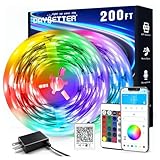
Overview: DAYBETTER’s massive 200-foot kit includes two 100-foot rolls designed for whole-home installations. This RGB strip supports dual control via smartphone app and 24-key IR remote, offering 16 million colors across an exceptionally long run. Music synchronization through the app transforms spaces into dynamic party environments. The timer function with color memory enables automated scheduling. Targeting large-scale decorators, it provides unprecedented coverage for ceilings, staircases, and commercial spaces at a budget price point.
What Makes It Stand Out: The sheer length dominates competitors—200 feet covers entire homes without additional purchases. Dual control flexibility accommodates both tech-savvy app users and those preferring simple remote operation. The music sync feature analyzes smartphone audio, making it ideal for parties. Smart timing with color memory remembers your preferences across power cycles. Splitting into two 100-foot rolls simplifies installation in separate rooms or complex layouts, reducing voltage drop issues common in ultra-long single strips.
Value for Money: Offering 200 feet at a price point where competitors provide 32-65 feet, the value proposition is undeniable. Cost-per-foot makes it the most economical choice for large projects. While lacking advanced RGBIC or WiFi features, it delivers core RGB functionality reliably. The included IR remote adds value for households with multiple users. Compromises in LED density and brightness are expected trade-offs for extreme length at this price.
Strengths and Weaknesses: Strengths: Unbeatable length for price; Dual app/IR control; Music synchronization; Timer with color memory; Split-roll design; Strong adhesive; Easy installation.
Weaknesses: No RGBIC or multi-color segments; No voice assistant support; Potential connectivity issues over 100ft runs; Lower brightness than premium strips; Adhesive may fail in humid environments; Requires careful power supply placement.
Bottom Line: The go-to solution for covering large spaces economically. Ideal for party venues, dorm halls, or ambitious home projects where length trumps advanced features. Accept its limitations and you’ll get incredible coverage for minimal investment.
9. DAYBETTER LED Strip Lights 130ft Lights Strip for Bedroom, Desk, Indoor Room Bedroom Brithday Gifts RGB Decor with Remote and 24V Power Supply

Overview: DAYBETTER’s 130-foot RGB strip balances length and manageability for medium-to-large room installations. Supporting both app and 24-key IR remote control, it offers 16 million colors with music synchronization and smart timing functions. The 24V power supply ensures more stable brightness across longer runs than typical 12V systems. Designed for bedroom and living room aesthetics, it provides ample coverage for ceiling perimeters, under-bed lighting, or desk backdrops without the excess of 200-foot kits.
What Makes It Stand Out: The 24V power infrastructure reduces voltage drop, maintaining consistent brightness from start to end—an improvement over 12V competitors. Music sync via smartphone microphone creates responsive ambiance for entertainment. The timer function with color memory enables wake-up lighting and automated evening scenes. At 130 feet, it hits a sweet spot: long enough for most bedrooms yet manageable without professional installation. The dual control system accommodates different user preferences within the same household.
Value for Money: Positioned as a mid-range option, it offers excellent length-per-dollar while including app and remote control. The 24V system adds technical value, preventing the dimming issues plaguing longer 12V strips. Compared to premium WiFi-enabled brands, it sacrifices voice control for raw length and affordability. For users wanting extensive coverage without ecosystem lock-in, it delivers practical functionality. The included power supply and connectors complete the package without requiring additional purchases.
Strengths and Weaknesses: Strengths: 130-foot generous length; 24V stable power delivery; Dual app/IR control; Music sync capability; Timer with memory; Easy DIY installation; Good brightness consistency.
Weaknesses: No RGBIC multi-color segmentation; Lacks voice assistant integration; Bluetooth-only connectivity; App interface less polished than premium brands; Adhesive strength varies by surface; No smart home automation.
Bottom Line: A pragmatic choice for bedroom and living room makeovers needing substantial length without premium pricing. Perfect if you want app-controlled ambiance and music sync without committing to a full smart home ecosystem. Reliable performance for the price.
10. Govee Smart RGBIC LED Strip Lights 65.6ft, Alexa LED Light Strip Work with Google Assistant, Music Sync, DIY Multiple Colors on One Line, WiFi Color Changing Lights for Bedroom, Living Room, Holiday

Overview: Govee’s 65.6-foot WiFi-enabled RGBIC strip merges advanced segmented color technology with full smart home integration. Supporting Alexa and Google Assistant, it displays multiple colors simultaneously per segment while offering voice control, app customization, and AI-generated themes. The upgraded music sync includes 11 modes with high-sensitivity mic integration. With 64+ preset scenes and a thriving DIY community, it targets users wanting premium RGBIC effects combined with seamless smart home automation for bedrooms, living rooms, and holiday decorations.
What Makes It Stand Out: This strip uniquely combines RGBIC segmentation with WiFi and voice control—a rare trio at this price. The AI-created themes from photo uploads generate personalized lighting schemes automatically. Alexa’s upgraded integration controls scene and music modes via voice, not just basic on/off. The Govee Home App’s community features let users share and download thousands of custom effects. At 65.6 feet, it covers large spaces while maintaining color accuracy and brightness. The segmented control enables flowing gradients, chase effects, and holiday animations impossible with standard RGB.
Value for Money: Mid-range pricing delivers premium features: RGBIC, WiFi, voice control, and AI themes. While costlier than Bluetooth-only Govee models, it undercuts Philips Hue and LIFX alternatives by 40-60%. The feature set justifies the premium over basic RGB strips. For smart home users wanting RGBIC effects without ecosystem lock-in, it offers exceptional flexibility. The robust app and regular firmware updates extend long-term value beyond initial purchase.
Strengths and Weaknesses: Strengths: RGBIC + WiFi + Voice control; Alexa scene mode control; AI photo themes; 65.6-foot length; 11 music modes; Active DIY community; Regular app updates; Good brightness.
Weaknesses: Requires 2.4GHz WiFi; More expensive than Bluetooth version; Adhesive could be stronger; Some advanced features have learning curve; No SmartThings integration; Power supply could be bulky for some installations.
Bottom Line: The sweet spot for smart home enthusiasts wanting RGBIC effects with voice control. Its combination of length, segmentation, and WiFi integration makes it the most versatile option under $100. Highly recommended for Alexa/Google households seeking dynamic, customizable lighting.
Understanding Voice-Controlled Smart LED Strip Lights
What Makes Them “Smart” in 2026
Today’s smart LED strips go far beyond basic on/off functionality through a smartphone app. True intelligence in 2026 means native, low-latency voice processing that doesn’t require constant cloud connectivity, advanced scene recognition that adapts to your daily patterns, and predictive algorithms that suggest lighting adjustments based on time of day, weather, or even your calendar events. The most sophisticated models feature edge computing capabilities, allowing them to execute complex multi-step commands locally without the frustrating delays that plagued earlier generations.
How Voice Control Technology Works
Modern voice-controlled strips rely on a three-tier architecture: the microphone array in your smart speaker or display, the natural language processing engine (either cloud-based or local), and the LED controller’s API that translates commands into precise electrical signals. The magic happens in the handshake between these components—quality strips feature certified integration that ensures “Alexa, set the kitchen counter to sunset orange” produces exactly the right RGB values without manual tuning. Look for devices that support intent recognition, meaning they understand contextual commands like “make it cozier” or “gaming mode” rather than just rigid, pre-programmed phrases.
Key Features to Evaluate Before Buying
Brightness Levels and Lumen Output
Voice-controlled ambiance falls flat if your strips can’t produce sufficient illumination. Measure brightness in lumens per meter rather than raw LED count—a high-density 60-LED strip with efficient diodes often outperforms a 120-LED strip using outdated components. For accent lighting behind furniture, 200-400 lumens per meter suffices, while task lighting under cabinets demands 600+ lumens. Premium 2026 models achieve 1000+ lumens per meter while maintaining color accuracy, though you’ll need adequate heat dissipation to prevent premature failure.
Color Range and Accuracy
The difference between “meh” and mesmerizing lies in color reproduction. Seek strips offering true 16-million-color capability through 24-bit color depth, but don’t stop there—verify the RGBWW (Red, Green, Blue, Warm White, Cool White) configuration, which enables richer pastels and authentic whites. Color accuracy matters tremendously for voice commands like “match the candlelight” or “tropical ocean blue.” Check for a Color Rendering Index (CRI) above 90 for the white channels; anything lower makes your space look washed out and clinical when you’re not using saturated colors.
Strip Length and Customization Options
Standard reels come in 5-meter lengths, but your project might need 3.2 meters or 12 meters total. Quality strips provide clearly marked cut points every 2-5 inches, with copper pads designed for reliable reconnection using either soldered joints or snap-on connectors. Expandability through official extension kits prevents voltage drop issues that cause dimming and color inconsistency at the far end. For voice control specifically, ensure the controller can handle your maximum planned length without requiring multiple power injectors that complicate voice grouping.
Connectivity Standards Matter
Wi-Fi 6E support has become the gold standard in 2026, offering dedicated 6 GHz bands that avoid congestion from your streaming devices and security cameras. Thread and Matter protocols deliver mesh networking reliability without hogging bandwidth, crucial for maintaining instant voice response times. Bluetooth 5.3 provides reliable fallback connectivity when your router hiccups. Avoid strips that rely solely on 2.4 GHz Wi-Fi—they’ll struggle in crowded apartment buildings and produce maddening delays between your voice command and the light response.
Power Consumption and Efficiency Ratings
Voice-controlled strips sip power in standby mode—premium models draw less than 0.5 watts when idle. During operation, efficiency varies wildly: budget strips might consume 14 watts per meter for moderate brightness, while cutting-edge COB (Chip On Board) designs achieve the same output at 7 watts. This matters for both your electricity bill and heat generation. Look for Energy Star certification or equivalent ratings, and verify the power supply includes over-voltage protection—cheap adapters can fry your investment during power surges.
Voice Assistant Compatibility Deep Dive
Native Integration vs Workarounds
Genuine native integration means the manufacturer has completed official certification with Amazon, Google, Apple, or Samsung—resulting in a seamless setup process and reliable skill/action performance. Workaround solutions using IFTTT or custom SmartThings handlers introduce lag and break frequently when platforms update. In 2026, native integration also enables advanced features like Alexa’s Hunches (automatically dimming lights when you say “goodnight”) or Google Assistant’s Continued Conversation (adjusting brightness after your initial color request without repeating the wake word).
Multi-Platform Household Strategies
If your home mixes Alexa in the kitchen with Google Assistant in the living room and Siri on everyone’s iPhone, you need strips that support simultaneous multi-assistant pairing. Some controllers allow this natively; others require careful hub configuration. The key is avoiding devices that force you to factory reset and re-pair when switching ecosystems. Look for Matter-certified strips—they promise true cross-platform compatibility, though in practice, some advanced features still work best within a single ecosystem.
Regional Language Support
Voice control sophistication varies dramatically by language and region. English commands enjoy the most robust support, but 2026 has seen major improvements in Spanish, Mandarin, German, and French. If you’re bilingual or live in a multilingual household, verify that the strip’s companion app supports multiple languages simultaneously. Some models can understand “turn off the lights” and “apaga las luces” without manually switching settings—a critical feature for diverse families.
Installation and Setup Considerations
Surface Preparation Best Practices
Even the most advanced voice-controlled strip fails if it peels off after two weeks. Clean surfaces with isopropyl alcohol, not just household cleaners that leave residue. Rough up glossy surfaces with fine-grit sandpaper for better adhesion. Premium 3M VHB tape backing makes a noticeable difference—if the manufacturer doesn’t specify the adhesive type, it’s probably budget foam tape that will fail. For voice control reliability, ensure the controller unit mounts in a location with strong Wi-Fi signal; metal cabinets and concrete walls can block commands from reaching the device.
Cutting, Splicing, and Extending
Voice-controlled strips require special attention when cutting—severing the wrong place can disable the data line that carries voice commands to downstream LEDs. Quality strips mark cut points clearly and maintain circuit continuity for the data signal. For extensions, use manufacturer-approved connectors; generic clips often introduce resistance that causes color drift and voice command failures at the strip’s far end. If soldering, use flux-core solder and keep heat on the pads for less than 3 seconds to avoid damaging the delicate IC chips that interpret your voice commands.
Controller Placement Strategies
The controller box—the brains connecting your strip to Wi-Fi and voice assistants—needs careful positioning. Mount it within 10 feet of your router or Thread border router for optimal response times. Avoid stuffing it behind televisions or inside walls where heat builds up and signals attenuate. Many 2026 controllers include signal strength LEDs—use these during installation to find the sweet spot. Consider ventilation; a controller running hot will throttle performance, introducing frustrating delays between your voice command and the light’s response.
Performance Metrics That Matter
Response Time and Latency
The true test of voice control quality is the time between finishing your command and seeing the light change. Premium strips achieve under 200ms response times—literally faster than you can snap your fingers. Budget options often take 1-3 seconds, creating a disjointed experience that feels anything but smart. Test this during setup by measuring the delay for simple commands like “turn on” and complex ones like “set to 75% brightness and warm white.” Consistency matters more than raw speed; erratic delays indicate poor network optimization.
Color Rendering Index (CRI) Explained
When you command “match the sunset,” low-CRI strips produce a muddy orange-pink that looks nothing like the real sky. High-CRI white channels (90+ for general use, 95+ for photography or art display) render colors accurately and make your voice-controlled scenes believable. Some manufacturers game the system by reporting CRI only for the white diodes while the RGB colors remain washed out. Look for TM-30 fidelity index scores, which provide a more comprehensive color accuracy measurement across the entire spectrum your voice commands will access.
Lifespan and Durability Ratings
Voice-controlled strips should last 25,000-50,000 hours—over a decade of typical use. However, heat is the enemy of LED lifespan and voice recognition accuracy. Strips mounted without proper heat sinks or used at maximum brightness constantly will degrade faster. Check the IP rating for moisture resistance; IP65 handles kitchen steam and bathroom humidity, while IP67 survives temporary submersion for outdoor installations. The controller’s capacitors often fail before the LEDs—look for models with replaceable controllers rather than integrated units that become e-waste when one component dies.
Smart Home Integration Ecosystem
Hub Requirements and Hub-Free Options
Direct-to-Wi-Fi strips offer simplicity but can overwhelm your network with 30+ devices. Hub-based systems (SmartThings, Hubitat, HomeKit with HomePod) create a dedicated mesh that isolates lighting traffic and enables local voice processing for faster response. Thread-enabled strips represent the best of both worlds—hub-free setup via your existing smart speakers, but with mesh reliability. Evaluate your current ecosystem: if you already own a hub, strips that leverage it often provide more reliable voice control and advanced automation options.
Automation Scenes and Routines
The real power of voice control emerges when strips participate in complex routines. “Movie night” should dim your overhead lights, turn on bias lighting behind the TV, and lock the front door—all triggered by a single phrase. Verify that your chosen strips support adjustable transition times (gradual dimming over 30 seconds feels more natural than instant off), conditional logic (different brightness based on time of day), and state persistence (remembering the last setting after power outages). Some 2026 models even learn your preferences, automatically adjusting scenes based on which family member issued the voice command.
Third-Party Service Compatibility
Beyond the major voice platforms, consider integration with Home Assistant, Hubitat, or other open-source platforms if you want ultimate customization. IFTTT support has become less critical as native integrations improve, but it’s still valuable for obscure triggers. Check for API documentation availability—enthusiast communities often create superior voice control plugins when manufacturers provide open APIs. Avoid strips that require closed, cloud-only services; if the company shuts down its servers, your voice commands become worthless paperweights.
Budget and Value Analysis
Understanding Price Tiers
Entry-level voice-controlled strips ($15-25 per meter) offer basic RGB, decent brightness, and single-assistant support. Mid-range options ($30-50 per meter) add RGBWW, better CRI, multi-assistant compatibility, and robust adhesive. Premium strips ($60-100+ per meter) deliver professional-grade color accuracy, ultra-low latency, Matter/Thread support, and aluminum channels for heat management. For most homeowners, the sweet spot lies in the $35-45 range, where you get 90% of premium performance without diminishing returns.
Hidden Costs to Factor In
That bargain strip isn’t so cheap when you add a $30 power supply, $15 worth of connectors, $20 for aluminum channels, and $10 for a better adhesive. Controllers that require proprietary hubs add $50-100 to your total. Energy costs matter too—a strip that uses twice the power for the same brightness costs an extra $5-10 annually per meter. Factor in subscription fees; some manufacturers now charge monthly for advanced voice features or cloud storage of your custom scenes. Always calculate total cost of ownership over a 5-year period.
Long-Term Value Proposition
A $80 strip that lasts 8 years costs less per year than a $25 strip you replace every 18 months. Consider firmware support—reputable manufacturers provide updates for 3-5 years, adding new voice commands and fixing bugs. Check user forums for reports of premature failure and customer service responsiveness. A strong warranty (2+ years) indicates manufacturer confidence. For voice control specifically, value means consistent performance that doesn’t degrade as your smart home grows more complex.
Troubleshooting and Maintenance
Common Voice Command Issues
When “turn on the lights” results in silence, systematically diagnose: first check if the strip responds to app control (isolating voice vs connectivity issues), then verify the microphone heard you correctly in the assistant’s activity log. Network congestion often causes intermittent failures—try prioritizing the strip’s MAC address in your router’s QoS settings. Firmware mismatches between the controller and your smart speaker create compatibility bugs; ensure both update automatically. If commands work sporadically, electromagnetic interference from nearby appliances might be corrupting the Wi-Fi signal—relocate the controller away from microwaves and baby monitors.
Firmware Update Best Practices
Manufacturers push firmware updates to improve voice recognition and patch security vulnerabilities. Enable automatic updates but schedule them for 3 AM to avoid mid-day interruptions. Never unplug a strip during an update—this bricks the controller. Before major updates, back up your custom scenes and voice command shortcuts; occasionally updates reset configurations. Subscribe to manufacturer newsletters to learn about new voice features added via firmware. Some 2026 models offer beta firmware channels for early access to experimental voice commands, though these may introduce instability.
When to Replace vs Repair
A single dead LED segment doesn’t justify replacement—cut it out and splice the remaining sections. However, if the controller fails and costs $40 to replace on a $50 strip, upgrade instead. Voice control modules that lose Wi-Fi connectivity frequently despite troubleshooting indicate failing capacitors; these are repairable if you’re handy with a soldering iron, but most users should replace. When manufacturers end firmware support (usually announced 6 months in advance), consider upgrading to maintain security and compatibility with evolving voice platforms. Flickering that persists after power cycling often precedes total failure—replace proactively before you’re left in the dark.
Future-Proofing Your 2026 Purchase
Emerging Standards to Watch
Matter 1.3 has solidified device interoperability, but Matter 2.0 promises advanced voice features like emotion-aware lighting that responds to vocal tone. Wi-Fi 7 routers are becoming mainstream—ensure your strip’s controller has firmware-upgradeable radios to leverage future speed improvements. Energy harvesting strips that recharge via ambient light are in early development, potentially eliminating power cords. AI-driven voice models that learn your accent and slang will require more powerful controllers; buy devices with at least 512MB RAM and recent ARM processors to support these updates.
Scalability for Growing Smart Homes
Start with a controller rated for twice your initial strip length—adding extensions later is simpler than replacing an undersized controller. Choose strips that support controller grouping, allowing one voice command to control multiple separate strips as a unified zone. Verify your Wi-Fi network can handle expansion; each strip consumes 2-5 Mbps of bandwidth for voice control overhead. For large installations, plan for multiple power supplies rather than voltage injectors—they’re more reliable and make troubleshooting easier when voice commands affect only part of your installation.
Privacy and Security Considerations
Voice-controlled devices are potential entry points for hackers. Prioritize strips with local voice processing options that don’t transmit every command to the cloud. Check for AES-128 encryption minimum, and verify the manufacturer has a bug bounty program indicating security commitment. Disable unused features like remote access if you only need local voice control. Some 2026 models include physical microphone kill switches on the controller—valuable for bedrooms where privacy concerns outweigh convenience. Read privacy policies carefully; some manufacturers monetize your usage patterns and voice command data.
Frequently Asked Questions
How do I know if a smart LED strip truly supports voice control or just basic app control?
Check for official certification badges from Amazon (Works with Alexa), Google (Google Home compatible), or Apple (HomeKit certified) on the packaging. Genuine voice control devices appear automatically in your assistant’s device discovery list without requiring third-party skill installation. The companion app should include a “voice training” or “assistant linking” section in settings. Be wary of products that mention “voice control compatible” but require IFTTT or complex workarounds—this indicates unofficial integration that often breaks.
Can I control multiple LED strip zones with one voice command?
Yes, but it depends on your ecosystem. Within a single voice platform, create room groups or zones (e.g., “living room lights” controlling both TV backlighting and shelf strips). For cross-zone scenes like “party mode,” use your assistant’s routine feature to link multiple strips to one trigger phrase. Matter-enabled strips simplify this by supporting native multi-device commands. Avoid connecting too many strips to a single overloaded controller—split them across multiple controllers grouped in software for better reliability.
Will smart LED strips work when my internet is down?
It varies by model. Strips using Thread or Zigbee with a local hub (HomePod, SmartThings) continue working for basic on/off and color changes during internet outages. Wi-Fi-only strips that process voice commands in the cloud will fail until connectivity returns. Some premium 2026 models feature hybrid processing—simple commands execute locally while complex scenes require cloud access. Check the specs for “offline mode” or “local voice processing” support if this is a priority.
What’s the maximum length I can run while maintaining reliable voice control?
For 12V strips, limit continuous runs to 5 meters to prevent voltage drop and signal degradation. 24V systems can handle 10 meters reliably. Beyond these lengths, the data signal that carries voice commands weakens, causing unresponsive segments or color inaccuracies. Use amplifiers or additional controllers for longer installations. For voice control specifically, multiple shorter strips connected to one controller often perform better than one long strip, as the data signal stays strong throughout each segment.
Do I need a special router for optimal voice control performance?
Not necessarily, but a modern mesh system helps immensely. Voice commands require low latency, so prioritize routers with QoS (Quality of Service) settings that can prioritize lighting traffic. Wi-Fi 6E or Wi-Fi 7 routers provide dedicated bandwidth that prevents your streaming 4K video from delaying light responses. For Thread-enabled strips, you need a Thread border router (included in HomePod mini, Nest Hub 2nd gen, and some Eero models). Ensure your router supports multicast routing, which many voice control protocols depend on—cheap ISP-provided routers often block this.
How accurate are voice commands for specific colors?
Surprisingly accurate with quality strips. Premium models map over 1000 color names to precise RGBWW values, so “chartreuse” or “cerulean” produce consistent results. The assistant’s language model matters too—Alexa and Google recognize more color names than Siri. For exact brand colors (like a sports team’s specific shade), use the app’s color picker once, then save it as a custom scene with a memorable voice name. Be aware that very dark colors (under 10% brightness) may appear inaccurate due to LED calibration limitations.
Can guests control the lights without accessing my entire smart home?
Absolutely. Enable guest mode in your assistant settings, which allows voice commands without unlocking personal data. Some 2026 strips support temporary access codes—guests scan a QR code that grants 24-hour voice control limited to specific zones. Physical control options like wireless dimmer switches paired to the strip give guests manual control without voice access. For Airbnb rentals, consider strips with a dedicated guest network mode that isolates lighting control from your primary smart home ecosystem.
What’s the difference between RGB, RGBW, and RGBWW for voice control?
RGB strips mix red, green, and blue to approximate white, resulting in a harsh, cold light. RGBW adds a dedicated white diode for true white but lacks warm tones. RGBWW includes both warm and cool white diodes, enabling voice commands like “warm candlelight” or “cool daylight” that sound natural. For voice control, RGBWW is essential—assistants can differentiate between hundreds of white temperatures, but only if the hardware supports it. RGBWW also produces more accurate pastels and earth tones when mixing colors with white.
How do I prevent voice commands from triggering the wrong lights?
Use specific, unique names for each strip zone—“kitchen under-cabinet” beats ambiguous “kitchen lights.” Train your assistant’s voice recognition to distinguish family members, preventing kids from controlling bedroom strips. Set up confirmation chimes for critical zones (like outdoor lights) so you know the correct device responded. In open floor plans, leverage ultrasound presence detection in smart speakers to target commands to the room you’re physically in. Regularly review your assistant’s activity log to catch misinterpreted commands and adjust naming accordingly.
Are there any health concerns with voice-controlled LED strips?
Quality strips pose minimal health risks, but cheap models may flicker imperceptibly at frequencies that cause eye strain and headaches—this flickering often worsens when processing voice commands due to power fluctuations. Ensure your strips have a flicker-free certification (IEEE 1789 compliant). Blue light exposure is another concern; use voice commands like “enable night mode” to automatically filter blue wavelengths after sunset. Some people report electromagnetic sensitivity from Wi-Fi-enabled devices—Thread/Zigbee strips emit lower power signals and may be preferable. Always buy strips with UL or ETL safety certification to avoid fire hazards from overloaded power supplies.
See Also
- 10 Best Smart LED Strip Lights for Voice Control Integration in 2026
- 10 Best Remote Control LED Strip Lights for Easy Operation This Year
- 10 Game-Changing Smart LED Strip Lights for Home Automation in 2026
- The 10 Most Revolutionary Smart LED Strip Lights of 2026
- 10 Best Remote Control LED Strip Lights for Bedrooms This Year