Table of Contents
Imagine walking into your living room after a sweltering day, and before you even think to reach for a switch, the ceiling fan adjusts to a perfect, cooling breeze. The lights dim to a relaxing hue, all because your home automation system recognized your arrival pattern and the rising outdoor temperature. This seamless integration isn’t science fiction for 2026; it’s the expected standard for modern smart ceiling fans. Gone are the days of simple pull chains and basic remotes. Today’s intelligent fans are sophisticated climate control hubs, learning your preferences, adapting to environmental shifts, and becoming indispensable elements of a truly responsive living space. They represent a quiet revolution where comfort meets intelligence, transforming a fundamental household fixture into a cornerstone of effortless, personalized home management.
The evolution of the humble ceiling fan into a smart home linchpin reflects a broader shift towards intuitive, health-conscious living. Homeowners increasingly seek solutions that don’t just automate tasks but actively enhance well-being and efficiency. Smart ceiling fans now contribute significantly to energy savings, improved air circulation for better indoor air quality, and even circadian rhythm support through integrated lighting. As home automation ecosystems mature, the ceiling fan has shed its purely functional role, emerging as a central node that connects environmental sensing, user behavior, and whole-home comfort strategies. Choosing the right one isn’t just about moving air; it’s about selecting a key player in your home’s intelligent future, one that works silently in the background to create a healthier, more comfortable, and significantly smarter environment.
Top 10 Smart Ceiling Fans
Detailed Product Reviews
1. Dreo Smart Ceiling Fans with Lights, Low Profile Ceiling Fan with Alexa/App, 52’’ Dimmable Lighting & Color Tuning, RGB Ambient Light for Living Room, Game Room, Easy Installation, Quiet, Black

Overview: The Dreo 52" smart ceiling fan combines robust airflow (6,040 CFM max) with advanced lighting control, targeting tech-savvy homeowners seeking ambiance customization. Its low-profile design suits standard ceilings in living or gaming spaces.
What Makes It Stand Out: Standout features include app-controlled RGB ambient lighting with modes like Breath and Circle, 12 adjustable fan speeds (beyond typical 6), and precise color temperature tuning (2,700K–6,500K). The 4231 CFM average airflow and sub-45dB operation balance power and quietness, while sunrise/sunset presets automate lighting.
Value for Money: Priced mid-to-high, it justifies cost with unmatched lighting versatility and strong airflow. Cheaper models lack RGB depth or app granularity, making this ideal for users prioritizing mood lighting alongside cooling.
Strengths and Weaknesses: Strengths: Effortless one-screw installation; memory function; Alexa/app integration; versatile airflow modes; quiet operation. Weaknesses: RGB complexity may overwhelm casual users; app connectivity occasionally laggy; no slope-mount support.
Bottom Line: A top-tier choice for ambiance-focused buyers wanting premium lighting control and reliable cooling, despite minor app quirks. Best for living rooms or game rooms where aesthetics matter.
2. Sofucor 52" Smart Ceiling Fan, Indoor/Outdoor Ceiling Fans with Lights and Remote, Compatible with Alexa/Google/App, 3-Color Light 6-Speed Timing Reversible DC Motor for Bedroom Living Room Patio

Overview: Sofucor’s 52" fan delivers versatile indoor/outdoor use with a DC motor, targeting energy-conscious buyers needing year-round airflow in bedrooms, patios, or living areas. Its triple-control system (app/voice/remote) simplifies operation.
What Makes It Stand Out: The ultra-quiet <30dB operation and 75% energy savings via DC motor outshine competitors. With 5,000 CFM airflow, 3 light temperatures (3,000K–6,000K), and slope-mount support (≤15°), it excels in patios or vaulted spaces where rivals lack adaptability.
Value for Money: Offers exceptional value for its price tier. Outperforms similar fans in noise reduction and energy efficiency, though airflow lags behind Dreo’s. Ideal for patio installations where weather resistance and quietness are critical.
Strengths and Weaknesses: Strengths: Near-silent operation; reversible airflow for seasonal use; includes three downrods; easy pre-assembled setup; robust Alexa/Google support. Weaknesses: Limited to 3 preset light colors (no RGB); app interface feels dated; lower max CFM than premium models.
Bottom Line: Highly recommended for patios or bedrooms prioritizing whisper-quiet, efficient operation. Skip if advanced lighting customization is essential.
3. ZMISHIBO 52 Inch Ceiling Fan with Light, App&Remote Control, Flush Mount Low Profile, Dimmable 20W LED Light, Quiet Reversible Motor for Bedroom, Living Room, Apartment, Black

Overview: This ZMISHIBO model focuses on simplicity, offering flush-mount design and dimmable lighting for apartments or bedrooms. Its 3,057 CFM airflow and 2,000-lumen LED suit compact to mid-sized rooms without smart-home frills.
What Makes It Stand Out: The stepless color temperature adjustment (3,000K→6,500K) and pure copper DC motor provide smooth lighting transitions and reliability at an entry-level price. Memory function and reversible airflow enhance usability for daily routines.
Value for Money: Best value for budget buyers wanting core smart features. Cheaper than Dreo/Sofucor but sacrifices RGB and high-CFM performance. Perfect for renters or small spaces needing basic app control without complexity.
Strengths and Weaknesses: Strengths: Affordable; easy 30-minute setup; quiet DC motor; sleek low-profile design; light memory function. Weaknesses: No RGB or advanced lighting modes; app requires Bluetooth (less reliable than Wi-Fi); limited to 3,057 CFM airflow.
Bottom Line: An excellent budget pick for apartments or bedrooms needing reliable, quiet operation—opt for this if smart features are secondary to simplicity and cost savings.
4. ZMISHIBO 52 Inch Smart Ceiling Fans with RGB Lights, Low Profile Flush Mount Ceiling Fan with Alexa/App/Remote Control, Dimmable 20W LED Light, Black Modern Fan for Living Room, Bedroom, Game Room

Overview: This ZMISHIBO variant upgrades its sibling with RGB lighting, targeting gamers or entertainers wanting vibrant atmospheres. The 52" fan retains flush-mount ease but adds 16 million color options via app control for living rooms or media spaces.
What Makes It Stand Out: The standout is its rhythmic RGB lighting (16M+ colors) with ambient modes, paired with stepless brightness (10%–100%) and color temperature tuning. Sub-30dB operation and 6-speed DC motor ensure quiet performance during movies or sleep.
Value for Money: Competitive pricing for RGB capabilities. While Dreo offers similar lighting, this undercuts it slightly with equally robust features. Best for cost-conscious buyers wanting party-ready lighting without premium markups.
Strengths and Weaknesses: Strengths: Rich RGB customization; sturdy plywood blades; reversible airflow; 30-minute installation; light memory function. Weaknesses: App connectivity unstable without Bluetooth; no slope-mount; RGB drains energy faster than standard LEDs.
Bottom Line: Highly recommended for game rooms or entertainment spaces needing immersive lighting. Choose over Product 3 if RGB is non-negotiable, but avoid for patios due to indoor-only design.
5. AQUBT Smart Ceiling Fans with Light and Remote,20’’ Low Profile Ceiling Fan with 6-Speed & Dimmable LED, Alexa/APP Home Voice Control, App, Reversible Airflow, App Timer, for Bedroom(Black)

Overview: AQUBT’s compact 20" fan targets small bedrooms or offices, emphasizing ultra-bright lighting (4,800 lumens) over airflow. Its niche is illuminating tight spaces where larger fans would overwhelm, with precise app scheduling.
What Makes It Stand Out: The 4,800-lumen LED (60% brighter than rivals) and high-CRI lighting make it unique for task-oriented rooms. App timers down to the second and global remote access solve forgetfulness, while 3 light temperatures enhance functionality.
Value for Money: Priced fairly for its lighting prowess, though airflow (unstated CFM) is weaker than 52" models. Worth it for bedrooms needing bright, adjustable light—but overspending if cooling is primary.
Strengths and Weaknesses: Strengths: Exceptional brightness; granular timer control; energy-efficient; reversible airflow; easy setup. Weaknesses: Too small for living rooms; 2.4GHz Wi-Fi only; no RGB; basic app interface.
Bottom Line: A specialist pick for dim bedrooms requiring strong lighting—skip for larger rooms, but ideal for focused task lighting where space is limited.
6. Sofucor 52" Smart Ceiling Fan, Indoor/Outdoor Ceiling Fans with Lights and Remote, Compatible with Alexa/Google/App, 3-Color Light 6-Speed Timing Reversible DC Motor for Bedroom Living Room Patio

Overview: This 52-inch smart ceiling fan combines robust indoor/outdoor functionality with voice, app, and remote control. Designed for patios and rooms, it features a reversible DC motor, dimmable light, and energy-efficient operation.
What Makes It Stand Out: Its standout features include exceptional quietness (under 30dB), a powerful 5,500 CFM airflow, and true outdoor suitability with slope-mounting support (≤15°). The triple-light-temperature system (3,000K/4,000K/6,000K) with memory function and 75% energy savings over AC motors offer versatility and efficiency.
Value for Money: Priced competitively, it delivers premium outdoor durability and smart features often found in costlier models. The inclusion of three downrods (5"/10"/24") and easy 30-minute installation enhances its cost-effectiveness versus single-environment alternatives.
Strengths and Weaknesses: Strengths: Ultra-quiet DC motor, high airflow, seamless outdoor/indoor transition, and comprehensive control options. Weaknesses: Light brightness range isn’t specified, and the 6-speed option lags behind competitors offering 12 speeds. Outdoor use requires shelter from direct rain.
Bottom Line: An excellent all-in-one solution for covered patios and large rooms, balancing power, quiet operation, and smart convenience at a fair price—ideal for eco-conscious homeowners seeking year-round comfort.
7. Dreo Smart Ceiling Fans with Lights, 42 Inch Black Ceiling Fan, 12 Speeds & 3 Fan Modes, Stepless Color Tones, Dimmable LED Light, 1-12H Timer, Quiet DC Motor, Remote/APP/Alexa/Wall Switch Control
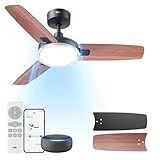
Overview: This 42-inch Dreo fan merges sleek design with advanced smart features, targeting style-conscious users. It offers precise airflow control, customizable lighting, and ultra-quiet operation for bedrooms or living spaces.
What Makes It Stand Out: The 12-speed app control (vs. 6 via remote), 2,400-lumen LED with a wide 2,700K–6,500K color range, and chic crystal light cover set it apart. FTC-certified 50% energy savings and reversible blades (black/wood grain) enhance its premium appeal.
Value for Money: Justifies its cost with superior lighting customization, whisper-quiet performance (<31dB), and dual-blade aesthetics. While pricier than basic models, the 12 speeds, app-exclusive modes (Auto/Sleep), and energy efficiency deliver long-term savings.
Strengths and Weaknesses: Strengths: Extensive lighting flexibility, elegant design, effortless seasonal reversal, and exceptional quietness. Weaknesses: Smaller 42-inch size limits coverage for large rooms; wall switch sold separately. 3,400 CFM airflow trails larger competitors.
Bottom Line: A top pick for those prioritizing design and lighting precision in medium-sized rooms, offering smart convenience and energy savings—perfect for modern bedrooms or stylish living areas.
8. SUNMORY 52" Ceiling Fans with Lights, Smart Ceiling Fan with APP and Remote Control, Reversible DC Motor, Noiseless, Stepless Dimmable, Modern Ceiling Fan for Indoor/Outdoor Use, Black

Overview: SUNMORY’s 52-inch fan delivers versatile indoor/outdoor performance with app, remote, and optional wall control. It emphasizes quiet operation and bright, adjustable lighting for patios or living spaces.
What Makes It Stand Out: The chandelier-style design blends elegance with function, while the 70% quieter DC motor (vs. AC) and 3,000K–6,000K dimmable light with memory stand out. Reversible dual-texture blades and broad room compatibility (patios excluded from rain) add value.
Value for Money: Competitive pricing for a 52-inch outdoor-capable model. The strong airflow, noiseless operation, and included remote/app control offer solid ROI, though the missing wall controller feels like a cost-cutting measure.
Strengths and Weaknesses: Strengths: Spacious 52-inch coverage, seamless light temperature adjustment, easy installation (<1 hour), and true outdoor versatility. Weaknesses: Wall controller not included; lacks app-exclusive features like scene scheduling found in rivals. Noise claims (<30dB) need real-world verification.
Bottom Line: A reliable, stylish choice for large rooms or covered patios seeking straightforward smart control and bright lighting—best for users wanting simplicity over app complexity.
9. Roomratv 52 Inch Smart Ceiling Fan with Light,App Control,Ultra Silent Reversible DC Motor Fan Remote Control Compatible with Alexa Google home(black)

Overview: Roomratv’s 52-inch fan focuses on universal smart compatibility and noise reduction, supporting multiple apps (SmartEra, Tuya) and voice control for effortless home integration.
What Makes It Stand Out: Triple-app support (SmartEra/Smartlife/Tuya) and precise voice commands (“set light to 18%”) provide unmatched flexibility. The 3000K–6000K light range, 6-speed settings, and sleep/natural modes cater to nuanced comfort needs.
Value for Money: Budget-friendly for its size and smart features, though noise claims (<50dB) are less impressive than rivals (<30dB). The timing function (1–8 hours) and reversible airflow justify the price for basic smart-home setups.
Strengths and Weaknesses: Strengths: Broad app compatibility, intuitive voice control, and energy-saving seasonal reversal. Weaknesses: Questionable “ultra-silent” label (50dB is audible); lacks modern touches like 12 speeds or stepless lighting. Installation support seems minimal.
Bottom Line: A functional entry-level option for smart-home beginners, but noise levels and feature gaps make it less compelling than quieter, more advanced competitors—suitable for cost-focused buyers in small-to-medium rooms.
10. Dreo Smart Ceiling Fan with Lights, 52 Inch, 12 Speeds & 3 Fan Modes, Stepless Color Tones, Dimmable LED Light, 12H Timer, Quiet DC Motor, Remote/APP/Alexa Control, White Ceiling Fans Indoor

Overview: Dreo’s 52-inch white fan excels in performance and customization, targeting users who demand high airflow and granular smart control for spacious interiors.
What Makes It Stand Out: Industry-leading 5,673 CFM airflow, 12-speed app control, and near-silent operation (“whisper-quiet”) differentiate it. The 1%–100% dimmable LED light (2,700K–6,500K) and one-touch seasonal reversal via app/remote add luxury.
Value for Money: Premium pricing is justified by superior airflow, flawless quietness, and comprehensive app features (preset scenes, stepless lighting). Outperforms most mid-range fans, though the white finish limits decor flexibility.
Strengths and Weaknesses: Strengths: Unmatched airflow, exceptional quietness, deep lighting customization, and intuitive app automation. Weaknesses: Only indoor use; white color may not suit all aesthetics. No wall switch included.
Bottom Line: The pinnacle of smart fan performance for large rooms—ideal for buyers prioritizing powerful, silent cooling and lighting precision, despite the higher cost and indoor-only limitation.
Understanding Smart Ceiling Fan Connectivity Ecosystems
Wi-Fi Direct vs. Hub-Dependent Operation
Understanding how your fan connects to your home network is paramount. Wi-Fi Direct models connect straight to your router, offering straightforward setup and direct app control from anywhere. However, they can consume more bandwidth and potentially cause network congestion if you have many devices. Hub-dependent fans, often using protocols like Zigbee or Z-Wave, require a separate smart home hub. While adding a step to installation, they typically create a more robust, lower-latency mesh network, crucial for reliable voice commands and complex automations involving multiple devices, especially in larger homes.
Voice Assistant Compatibility Landscape
Seamless voice control is non-negotiable for most smart home users. Fans must integrate flawlessly with major platforms like Amazon Alexa, Google Assistant, and Apple HomeKit/Siri. Look beyond simple “on/off” commands; true compatibility means precise control over speed levels, direction, light settings (if applicable), and integration into broader voice routines. For instance, saying “Alexa, I’m hot” could trigger your fan to ramp up while adjusting the thermostat. Ensure compatibility matches your existing or planned voice assistant ecosystem to avoid frustration.
Bluetooth Fallback Capabilities
While Wi-Fi is essential for remote access and cloud features, robust Bluetooth connectivity serves as a critical failsafe. If your home Wi-Fi experiences an outage, Bluetooth allows you to maintain local control via your smartphone app within the immediate vicinity of the fan. This ensures you never lose basic functionality during network disruptions, providing peace of mind and maintaining core comfort features even when the wider internet is down.
Multi-Protocol Support for Future-Proofing
As home automation standards evolve, fans supporting multiple communication protocols (like Matter over Thread) offer the best long-term investment. Matter, in particular, promises enhanced security, interoperability across different brands, and reduced reliance on specific cloud services. Choosing a fan with Matter certification (or clear upgrade paths) safeguards against your device becoming obsolete as the smart home landscape matures throughout 2026 and beyond, ensuring it remains compatible with next-generation hubs and controllers.
Essential Smart Features Beyond Basic Automation
Advanced Environmental Sensing Integration
The most capable smart fans go beyond remote control; they actively sense and respond to their surroundings. Integrated temperature and humidity sensors allow the fan to automatically adjust speed based on real-time room conditions, not just preset schedules. Some models even incorporate occupancy or motion detection, ensuring the fan operates only when needed, maximizing energy savings and comfort without requiring manual intervention.
AI-Powered Adaptive Learning Algorithms
True intelligence lies in adaptation. Fans equipped with AI learning capabilities analyze your usage patterns over time – when you typically turn them on, preferred speeds at different times of day, responses to weather changes. This allows the fan to proactively suggest or implement settings, gradually minimizing the need for manual adjustments. By 2026, this predictive comfort is shifting from a luxury to an expected feature for premium smart fans, creating a truly personalized environment.
Comprehensive Lighting Control Synergy
For fans with integrated LED lights, smart functionality should extend fully to illumination. This means independent control of brightness, color temperature (from warm white to cool daylight), and often full RGB color changing. Crucially, lighting should integrate seamlessly with fan operation within automations – think “Good Morning” routines that gradually increase fan speed and light intensity, or “Movie Time” scenes that dim lights and set a gentle breeze.
Customizable Scheduling and Geofencing Precision
Basic scheduling is table stakes. Advanced fans offer highly granular scheduling, allowing different settings for weekdays vs. weekends, or even specific hours. Geofencing takes this further, using your smartphone’s location to trigger actions. As you leave work, the fan can power down; as you approach home, it can activate to your preferred setting, ensuring comfort the moment you walk through the door, all while optimizing energy use.
Motor Technology and Performance Considerations
Brushless DC (BLDC) Motor Advantages
The heart of a premium smart fan is its motor. Brushless DC (BLDC) motors have become the dominant technology for high-end smart models, and for good reason. They are significantly more energy-efficient than traditional AC motors (often using 50-70% less power), operate almost silently, offer smoother speed transitions, and provide greater torque for moving air effectively at lower speeds. This efficiency directly translates to lower energy bills and a more pleasant user experience.
Airflow Efficiency Metrics Decoded
Don’t just look at maximum RPM; focus on airflow efficiency, measured in Cubic Feet per Minute (CFM) per Watt. A higher CFM/Watt ratio indicates the fan moves more air using less energy. Smart fans often provide real-time or historical energy usage data within their apps, allowing you to monitor efficiency. Consider the fan’s intended room size – a high-CFM fan is essential for large, open areas, while a more modest output might suffice for a bedroom, impacting both performance and energy draw.
Whisper-Quiet Operation Standards
Noise is a critical factor, especially in bedrooms or quiet living spaces. Smart fans should operate at noise levels well below 25 decibels on their lowest settings – comparable to a whisper. Look for specifications detailing noise output across all speed levels. Advanced motor designs, balanced blades, and quality bearings are key contributors to achieving truly silent operation, a non-negotiable feature for modern smart comfort.
Reversible Motor Functionality for Year-Round Use
A fundamental feature often overlooked in the smart rush is a reversible motor. In summer, the fan should spin counter-clockwise (as viewed from below) to create a cooling downdraft. In winter, reversing to clockwise pulls cool air up and pushes warm air trapped near the ceiling back down into the living space, improving heating efficiency. Ensure the smart controls make reversing effortless, ideally via app, voice command, or within seasonal automations.
Installation and Integration Practicalities
Retrofitting Existing Fixtures vs. New Construction
Consider your current setup. Many smart fans are designed as direct replacements for existing ceiling fans, utilizing standard mounting hardware and electrical boxes. However, ensure your existing junction box is rated for ceiling fan use (must support weight and movement). For new construction or major renovations, dedicated fan-rated boxes and potentially additional wiring (like a neutral wire, increasingly required for smart devices) should be installed during the rough-in phase for optimal and code-compliant smart fan integration.
Neutral Wire Requirement Awareness
A critical technical point often causing installation headaches is the neutral wire. Most modern smart fans, especially those with integrated lighting and advanced features, require a neutral wire at the ceiling electrical box to function correctly and power their electronics reliably. Older homes frequently lack this neutral wire at the switch box. Verify your wiring setup before purchase, as workarounds can be complex and may require an electrician, adding to the overall project cost and complexity.
Physical Control Options and Redundancy
While app and voice control are primary, having reliable physical controls remains important. Look for fans that include a robust, easy-to-use remote control with essential functions (speed, light, reverse). Some integrate discreet wall-mounted control panels that offer a more permanent solution than a remote. Physical controls provide crucial redundancy during power cycling, network outages, or for guests unfamiliar with your smart system, ensuring basic usability is never compromised.
Professional Installation Recommendations
Despite DIY appeal, professional installation is highly recommended for smart ceiling fans, particularly due to their weight, electrical complexity (neutral wires, potential for dual circuits for light/fan), and the importance of secure mounting. A licensed electrician ensures safety, compliance with local electrical codes, and proper balancing to prevent wobble or noise – issues that can be magnified with heavier smart fan units. The cost of professional installation is a worthwhile investment to avoid safety hazards and performance problems.
Maintenance and Long-Term Value
Self-Diagnostic Capabilities and Alerts
Advanced smart fans incorporate self-monitoring features. They can detect issues like blade imbalance, motor strain, or communication errors and send notifications directly to your smartphone app. This proactive maintenance alerting helps prevent minor problems from escalating into major failures, extending the fan’s lifespan and reducing unexpected downtime, contributing significantly to long-term reliability.
Over-the-Air (OTA) Update Importance
Like smartphones, smart fans require software updates to fix bugs, improve performance, add features, and crucially, patch security vulnerabilities. Ensure the model you choose has a proven history or clear commitment from the manufacturer to provide regular, seamless Over-the-Air (OTA) updates. Without ongoing updates, your fan’s functionality and security could deteriorate over time, diminishing its value and potentially creating network risks.
Blade Material and Cleaning Considerations
Smart functionality doesn’t negate the need for physical upkeep. Blade material impacts both aesthetics and maintenance. Solid wood offers beauty but requires careful dusting; engineered composites or metal blades are often easier to clean and more resistant to warping in humid environments. Consider how easily blades can be accessed and wiped down – some designs with tightly spaced blades or complex shapes make cleaning cumbersome, which is essential for maintaining optimal airflow and efficiency.
Warranty Coverage Depth
Scrutinize the warranty details. Look for comprehensive coverage that includes both the motor (typically 10+ years for quality BLDC motors) and the electronic components (smart hub, Wi-Fi module, lighting – ideally 2-3 years minimum). A strong warranty signals manufacturer confidence in both the mechanical durability and the reliability of the integrated smart technology, protecting your investment against premature failures in critical components.
Future-Proofing Your Smart Fan Investment
Matter Protocol Adoption Significance
Matter is the game-changer for smart home interoperability. Fans certified for Matter (running over Thread or Wi-Fi) promise simplified setup, enhanced security through local processing, and crucially, guaranteed compatibility across a vast and growing ecosystem of Matter-enabled hubs and controllers, regardless of brand. Choosing a Matter-compatible fan in 2026 is the single best step to ensure your fan remains useful and integrable as the smart home market standardizes, avoiding potential vendor lock-in.
Potential for Health and Wellness Integration
The next frontier involves deeper integration with health and wellness platforms. Imagine fans that adjust airflow based on data from your wearable, detecting elevated heart rate or sleep disturbances to optimize the sleep environment. Or integration with indoor air quality monitors, increasing circulation when VOC levels rise. While nascent, fans designed with open APIs or compatibility with health platforms offer pathways to these advanced, health-focused automations as the technology matures.
Energy Monitoring and Grid Interaction
As smart grids evolve, fans with granular energy monitoring could play a role in demand response programs. They might automatically adjust operation during peak energy pricing events signaled by your utility company, contributing to grid stability while potentially earning you rebates. Fans that provide detailed, real-time energy consumption data empower you to make informed choices about usage patterns and their impact on your overall household energy footprint.
Scalability Within Your Automation Ecosystem
Consider how the fan fits into your broader smart home vision. Does it integrate smoothly with your chosen hub to trigger or respond to actions from other devices (e.g., turning on when your robot vacuum starts to disperse dust, or syncing with smart vents for whole-home airflow management)? Choosing a fan that acts as a cooperative node within your ecosystem, rather than a siloed device, unlocks more sophisticated and valuable automations, maximizing the utility of your entire setup.
Frequently Asked Questions
Can smart ceiling fans work without an internet connection?
Yes, but with limitations. Local control via Bluetooth (if supported) or a physical remote usually remains functional during Wi-Fi outages. However, remote access from outside your home, voice control through cloud-based assistants, and complex automations relying on internet services will be unavailable until connectivity is restored.
How much energy do smart ceiling fans actually save compared to regular fans?
Smart fans, particularly those with BLDC motors, are significantly more efficient. BLDC motors can use 50-70% less energy than traditional AC motors. Combined with smart features like occupancy sensing, adaptive scheduling, and geofencing that prevent unnecessary operation, the overall energy savings compared to a standard fan left running manually can be substantial, often paying back the initial cost difference over time.
Is professional installation really necessary for a smart ceiling fan?
While DIY is possible for experienced individuals, professional installation is strongly recommended. Smart fans often have unique wiring requirements (like a neutral wire), are heavier, and require precise balancing. An electrician ensures safety, adherence to electrical codes, proper mounting to prevent wobble/noise, and correct integration with your home’s wiring, avoiding potential hazards or performance issues.
Do I need a smart hub for my smart ceiling fan?
It depends on the fan’s connectivity. Wi-Fi Direct fans connect straight to your router and typically don’t need a separate hub for basic functions. However, fans using Zigbee or Z-Wave do require a compatible smart home hub. Even for Wi-Fi fans, a hub can enable more reliable local processing, faster response times, and integration into complex automations within a broader smart home system.
Can smart ceiling fans help reduce heating costs in winter?
Absolutely. By reversing the motor direction (clockwise in most models), the fan pulls cool air up and pushes warm air that rises and collects near the ceiling back down into the living space. This gentle circulation allows you to set your thermostat lower in winter while maintaining comfort, potentially reducing heating energy consumption by up to 10%.
Are the apps for smart fans secure?
Security varies by manufacturer. Look for brands that prioritize security with features like end-to-end encryption, regular firmware updates via OTA to patch vulnerabilities, and strong password requirements. Avoid brands with a history of security breaches. Using a separate network VLAN for IoT devices adds an extra layer of security for your main home network.
How do I clean a smart ceiling fan without damaging the electronics?
Always turn off power at the circuit breaker first. Use a microfiber duster or a vacuum with a soft brush attachment for light dust. For heavier grime, slightly dampen a microfiber cloth with water or mild cleaner (never spray liquid directly onto the fan), wring it out well, and wipe blades carefully. Avoid excessive moisture near the motor housing or light fixtures. Consult the manual for specific guidance.
What does “CFM” mean and why is it important for smart fans?
CFM stands for Cubic Feet per Minute, measuring the volume of air a fan moves. Higher CFM means stronger airflow. Choosing the right CFM for your room size is crucial for effective cooling or circulation. Smart fans often display real-time or estimated CFM in their apps, helping you understand performance at different speeds and ensuring you select a model powerful enough for your space.
Can I control multiple smart ceiling fans as a group?
Yes, most smart fan apps and compatible smart home hubs allow you to create groups or zones. You can control all fans in a zone (e.g., “Upstairs Bedrooms”) simultaneously with a single command via app or voice (“Hey Google, turn off all upstairs fans”). This is essential for managing whole-home comfort efficiently within your automation routines.
Will my smart ceiling fan become obsolete in a few years?
Choosing a fan with Matter protocol support and a manufacturer committed to long-term Over-the-Air (OTA) updates significantly reduces obsolescence risk. Matter ensures future compatibility across platforms, while regular updates fix bugs, add features, and address security. Avoid proprietary systems without clear update paths or Matter support to maximize your fan’s usable lifespan in the evolving smart home landscape.
See Also
- 10 Must-Have Smart Ceiling Fans for Home Automation Enthusiasts in 2026
- 2026’s Top 10 Smart Ceiling Fans for Home Automation
- 10 Must-Have Smart Ceiling Fans for Home Automation in 2026
- 10 Best Smart Ceiling Fans with Lights for Home Automation in 2026
- We Tested 50 Smart Ceiling Fans with Lights - Here are the 10 Best for Home Automation